CULTURE / FAMILY & LEGACY
Mick Jagger and the Legacy a Father Leaves Behind: Why Money May Never Be the Greatest Gift
After decades of worldwide fame, the Rolling Stones frontman’s reflections on children, independence and inheritance raise a question that every parent can recognize.
A Different Kind of Legacy
For more than six decades, Mick Jagger has stood in front of crowds that know his songs by heart. His voice, stage presence and restless creative energy helped make the Rolling Stones one of the defining bands in rock history. Yet a question about his life beyond the stage may be more revealing than any discussion of records or ticket sales: what does a father truly leave his children? For a man whose family spans generations, the answer cannot be measured only in money. Jagger's public comments about fatherhood and inheritance suggest a more complicated picture, one in which independence, time and individual character matter alongside financial security.
 Mick Jagger onstage in London, 2018. Photo via Wikimedia Commons; see the file page for attribution and license.
Eight Children, Eight Individual Paths
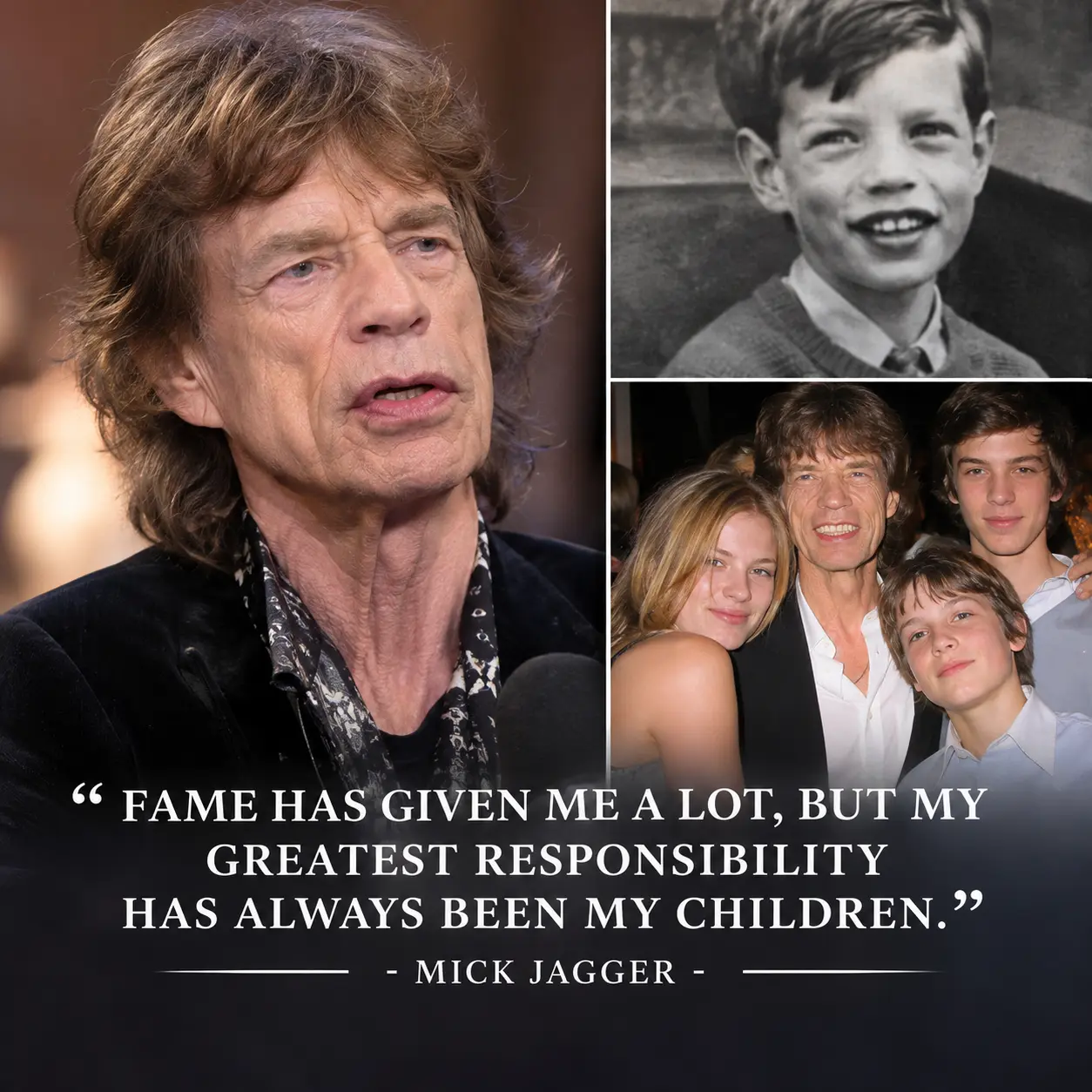
Jagger is the father of eight children, born across several decades. Their lives have followed different directions, from fashion and design to music, film and other pursuits. The variety matters because it challenges the idea that being born into a celebrated family determines who someone must become. A famous surname may open doors, but it also brings expectations. Children of stars can be compared with a parent before they have had the chance to discover their own talents. In that sense, an important parental gift is permission to be different. Jagger has spoken publicly about recognizing his children's individual interests and encouraging the activities toward which they naturally gravitate. That approach is less about manufacturing a second generation of rock stars and more about allowing each child a distinct identity.
 Mick Jagger onstage in London, 2018. Photo via Wikimedia Commons; see the file page for attribution and license.
What Money Can—and Cannot—Provide
A remark Jagger made in a 2023 interview about the Rolling Stones' music catalogue attracted attention because it questioned a familiar assumption about celebrity wealth. He suggested his children did not need an enormous inheritance to live well and raised the possibility of charitable giving. That was not a formal announcement of an estate plan. It was, however, a striking way to frame the difference between providing for children and defining their futures through wealth. Money can offer education, housing, safety and opportunity. It cannot automatically supply curiosity, compassion, judgment or the resilience needed when life refuses to follow a plan. Those qualities develop through experience and through the examples adults set. For parents without rock-star fortunes, the same principle can still resonate: the things children carry into adulthood are not always the things that appear on a balance sheet.
 Mick Jagger onstage in London, 2018. Photo via Wikimedia Commons; see the file page for attribution and license.
The Cost of Being Away
Jagger has also acknowledged a less glamorous side of his career. In a 2023 interview about parenting, he reflected on how touring and working away from home could limit the time available to enjoy life with his children. His comments were not a confession of a newly revealed family crisis. They were an observation familiar to many working parents: professional demands can compete with the ordinary moments that create closeness. A child may remember a conversation, a shared meal or a parent showing up on an unremarkable afternoon more vividly than a grand public achievement. Fame changes the scale of a career, but it does not erase that tension. For Jagger, the challenge has played out over decades; for other families, it might mean late shifts, business travel or a second job.
 Mick Jagger onstage in London, 2018. Photo via Wikimedia Commons; see the file page for attribution and license.
Fatherhood Changes With Time
One of the most interesting aspects of Jagger's family story is the extraordinary span between his oldest and youngest children. Parenting in one decade is not identical to parenting in another. The world changes, children change, and adults change with them. Jagger has described becoming more relaxed about parenting over time, while emphasizing that each child has a personality of their own. There is an important distinction between guidance and control. A parent can share values without insisting that every decision must reproduce the parent's life. Discipline may provide a foundation, but listening helps children learn how to stand on that foundation themselves. This is particularly relevant to families whose generations have grown up with different technologies, cultural expectations and ideas about success.
The Example That Outlasts Applause
The public often sees a rock legend through spectacular images: a microphone in his hand, a stadium illuminated, thousands of people singing together. Family life, by contrast, is usually built in private and in smaller gestures. No outsider can fully know what any celebrity's relationships with their children are like. Still, Jagger's interviews offer a useful starting point for a broader discussion about parenting. Is success the ability to give children everything they want, or the ability to help them recognize what matters? Does love mean removing every obstacle, or supporting children as they learn to face challenges? There are no universal answers, but the questions are worth asking precisely because they apply far beyond the world of music.
 Mick Jagger onstage in London, 2018. Photo via Wikimedia Commons; see the file page for attribution and license.
What Will They Remember?
The Rolling Stones' songs will likely remain part of popular culture for generations. That artistic legacy is already substantial. A family legacy is harder to quantify. It lives in values absorbed gradually, in opportunities to choose one's own path and in the sense that affection does not depend on fame or achievement. Jagger's reflections on parenting and inheritance do not prove he has solved those questions. They show that even someone associated with extraordinary wealth and success can speak about the limits of what money can do. Ultimately, the most powerful inheritance may be neither a fortune nor a famous name. It may be the confidence to build a meaningful life without needing to become a copy of the person who came before.
Background reporting: The Independent — Jagger on fatherhood (2023); The Guardian — catalogue and inheritance (2023). Photographs: Wikimedia Commons, 2018 collection.