MUSIC • HUMAN STORIES
MICK JAGGER AND THE HEARTBREAK THAT FAME COULD NEVER ERASE
The public knows Mick Jagger as a man in perpetual motion. For more than six decades, the Rolling Stones frontman has raced across stages, teased audiences with a raised eyebrow and delivered songs that have become part of the soundtrack of modern life. Yet one chapter of his story cannot be understood through a concert photograph or a chart position: the death of his longtime partner, fashion designer L’Wren Scott, in 2014.
Scott was more than a familiar figure beside a rock star. She had built her own creative identity, working as a stylist and designer with a distinctive eye for elegant silhouettes. Her relationship with Jagger placed her in the public gaze, but her work mattered independently of his fame. Remembering her only through the circumstances of her death would flatten a much larger life.
 Archival photograph of Mick Jagger / The Rolling Stones. Source: Wikimedia Commons.
When Scott died in March 2014, Jagger was on tour with the Rolling Stones. The band postponed performances in Australia and New Zealand. That decision made visible something that celebrity culture sometimes obscures: a musician may be an international institution, but he is also a person whose ordinary world can be abruptly changed by loss.
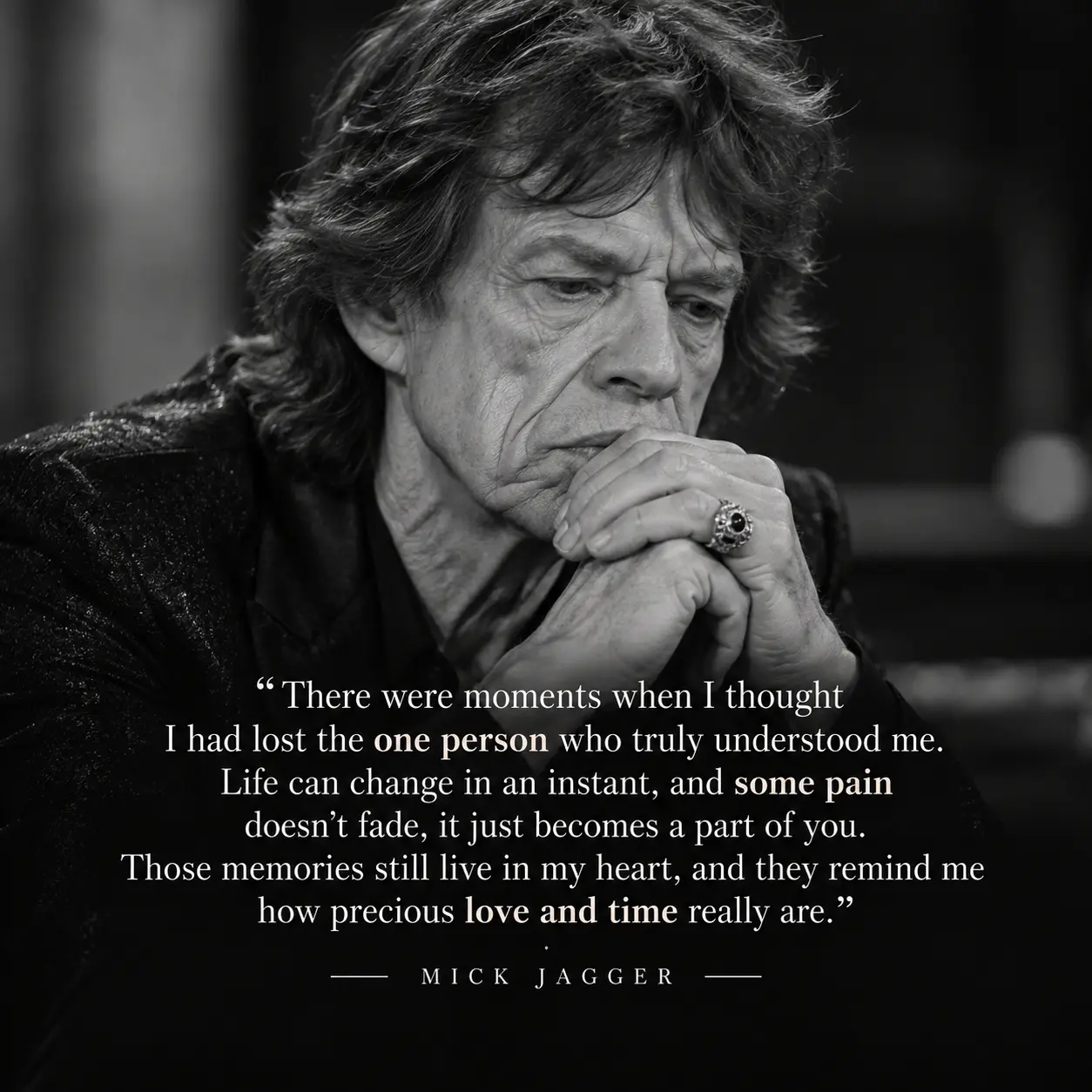
Jagger publicly expressed his devastation at the time. He also paid tribute to Scott’s talent and to the years they had shared. Those words belong to a particular moment of grief; they should not be stretched into invented conversations or treated as evidence of what he feels on any given day. What is clear is that the loss became a major turning point in the public account of his life.
 Archival photograph of Mick Jagger / The Rolling Stones. Source: Wikimedia Commons.
The contrast was painful. Onstage, Jagger had spent decades performing songs about desire, regret, freedom and longing. Audiences could sing every chorus. Offstage, no familiar lyric could provide a neat explanation for the absence of someone he loved. The crowd might have known the songs, but the experience of grief remained intensely personal.
That tension is one reason the story continues to resonate. The world often imagines celebrity as insulation from difficulty: wealth buys comfort, influence opens doors and applause offers reassurance. But none of those advantages changes the fundamental fact that relationships are fragile. A person can be recognized in every airport and still face moments that must be endured without an audience.
 Archival photograph of Mick Jagger / The Rolling Stones. Source: Wikimedia Commons.
There is also a quieter lesson in how Scott is remembered. She should not disappear behind the mythology of the Rolling Stones. Her designs, professional ambition and creative relationships deserve attention. To tell a story about Jagger’s heartbreak responsibly is to acknowledge the woman at its center as a complete person, not merely as the source of another celebrity’s sadness.
In the years after 2014, Jagger returned to performing and recording. The Rolling Stones continued to fill large venues, and his physical energy remained one of the band’s defining spectacles. It would be a mistake, however, to read those performances as proof that loss had simply been conquered. Returning to work can coexist with remembrance. Public resilience tells us very little about the private pace of healing.
 Archival photograph of Mick Jagger / The Rolling Stones. Source: Wikimedia Commons.
For fans who grew up with the band, the passage of time adds another layer. The Rolling Stones once seemed to represent endless youth and rebellion. Now their story also contains farewells, changing friendships and the recognition that even the loudest music cannot stop time. Jagger’s career has become a record not only of rock history but also of what it means to keep creating as life changes around you.
Perhaps that is why an old performance can feel different when watched today. The gestures are familiar, the voice instantly recognizable, and the crowd still rises. Yet behind the spectacle stands a life shaped by joy, work, relationships and grief. The audience sees the show; the person giving it carries everything that came before.
 Archival photograph of Mick Jagger / The Rolling Stones. Source: Wikimedia Commons.
The most respectful ending to this story is not a claim that Jagger has finally moved past the pain, nor a dramatic quotation nobody can verify. It is the simpler recognition that L’Wren Scott mattered, that her loss was real, and that the history of a rock legend includes human experiences no spotlight can fully reveal.