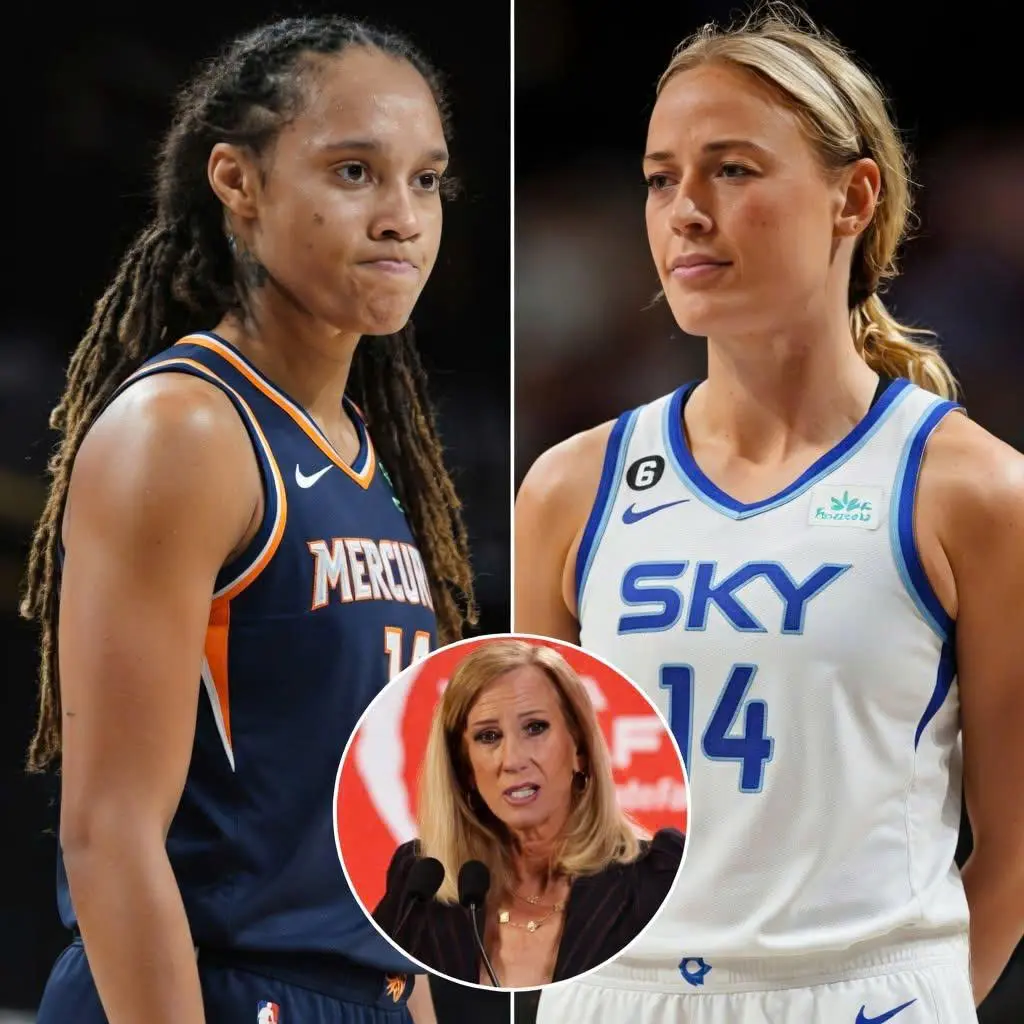
WNBA “Quit or Suspend Them” Claim: What the Evidence Shows About Griner, Reese, Clark and Cunningham
A dramatic claim says Brittney Griner and Angel Reese have threatened to leave the WNBA permanently unless Caitlin Clark and Sophie Cunningham are suspended. However, the research conducted for this article did not locate a verified joint statement, an authenticated interview, or a league announcement supporting that ultimatum. The supplied link was also inaccessible, meaning its underlying reporting could not be examined or independently confirmed.
That leaves an important distinction between a documented basketball confrontation and an unsupported claim about two other players’ intentions. The Fever and Connecticut Sun did have a heated encounter involving hard contact, confrontations, and ejections on June 17, 2025. But evidence that a difficult game occurred does not establish that Griner and Reese subsequently issued the career-ending threat described in the post. WNBA.com

The game’s date matters because the supplied passage presents its drama without a clear timeline. The documented contest took place in 2025, rather than being established here as a newly unfolding October 2026 crisis. Recycling an older confrontation alongside an undated ultimatum can make historical footage appear to prove a current development that the footage never actually addresses.
The WNBA’s official recap records an 88–71 Indiana victory over Connecticut. Clark contributed 20 points and six assists as the Fever secured a place in the Commissioner’s Cup championship game. Those details provide a reliable starting point: an identifiable matchup, a recorded result, and an official account that readers can compare with the sensational narrative. WNBA.com
There was genuine controversy surrounding the contest’s physical play. ESPN reported that tensions escalated during the third quarter after Jacy Sheldon made contact with Clark’s eye, followed by Clark pushing Sheldon away and Marina Mabrey knocking Clark to the floor. The sequence produced disciplinary calls, but it should be described through the recorded actions rather than language suggesting an organized conflict between opposing camps. ESPN
A separate incident occurred near the end of the game. With 46.1 seconds remaining, Cunningham committed a hard foul against Sheldon during a breakaway attempt, prompting another confrontation. Cunningham, Sheldon, and Lindsay Allen were ejected, making the final minute a legitimate subject for discussion about player safety and the handling of escalating tensions. ESPN
The subsequent disciplinary outcome is particularly important. ESPN reported that the WNBA said no players would be suspended following the scuffles, while Cunningham received an additional fine and Mabrey’s earlier technical was upgraded to a flagrant foul 2. That documented response differs substantially from a story depicting the league as still awaiting an ultimatum-driven decision about the same incident. ESPN
Those penalties do not prevent fans from debating whether the league responded appropriately. A reader might believe a hard foul deserved stronger punishment, while another might consider the announced sanctions sufficient. Either position is an opinion about a documented disciplinary response; neither establishes that Griner or Reese threatened to abandon their professional careers.
The alleged ultimatum therefore needs evidence of its own. An original recording, a statement published through an identifiable representative, or reliable reporting explaining when and where the remarks were made would allow the claim to be assessed. The supplied passage provides no exact quotation from either player, no named reporter who witnessed the announcement, and no clear date for the supposed demand.
Its wording instead relies on escalating descriptions: an unprecedented confrontation, an entire sport holding its breath, and the possibility of a league-wide “civil war.” These expressions create urgency without answering the central reporting questions. Readers still need to know who spoke, what each person actually said, where the statement appeared, and whether the two players were speaking together at all.
That last distinction is especially consequential. Separate criticisms from two athletes would not automatically amount to a coordinated ultimatum, even if both concerned officiating or player conduct. Combining remarks made at different times into a single demand could materially change their meaning, so any report alleging a joint threat should establish that connection explicitly.
The same standard applies to silence. A lack of an immediate denial does not authenticate an allegation, and an athlete should not be treated as having endorsed every statement circulated under her name. Verification requires affirmative evidence of the alleged remarks, rather than an assumption that public figures must rebut an unsupported post before it can be questioned.
There is a legitimate basketball story beneath the exaggeration. The June 2025 matchup raises questions about when officials should intervene, how dangerous contact should be evaluated, and whether postgame reviews produce consistent outcomes. Those subjects deserve examination through full sequences, disciplinary explanations, and clearly attributed comments, rather than through an invented confrontation among players not established as participants in the alleged announcement.

Careful coverage also needs to separate what happens during a possession from what someone supposedly intends beyond the court. Video may show contact, a reaction, or an argument, but it cannot independently establish a private motive or a future resignation plan. A dramatic clip can support a description of the play while offering no support for the much larger headline attached to it.
Photographs present a similar problem. Putting Griner and Reese beside Clark and Cunningham in a collage can visually suggest a shared dispute, even when the images come from unrelated games or appearances. Such an arrangement may illustrate the people named in a story, but it cannot serve as evidence that they met, coordinated a demand, or threatened to leave the league.
For anyone deciding whether to share the original post, the most useful question is straightforward: where is the original statement? A report making such a consequential allegation should provide a traceable answer. Without one, presenting the ultimatum as established news would go beyond the evidence available in this review.
The supported account is narrower and clearer. A heated Fever–Sun game occurred in June 2025, disciplinary action followed, and contemporary reporting said there were no suspensions arising from those scuffles. The separate allegation that Griner and Reese demanded Clark and Cunningham’s suspensions under threat of permanently leaving the WNBA remains unverified here and should not be presented as a confirmed league crisis. WNBA.com
Reference images identify the athletes discussed. They do not document or authenticate the alleged ultimatum