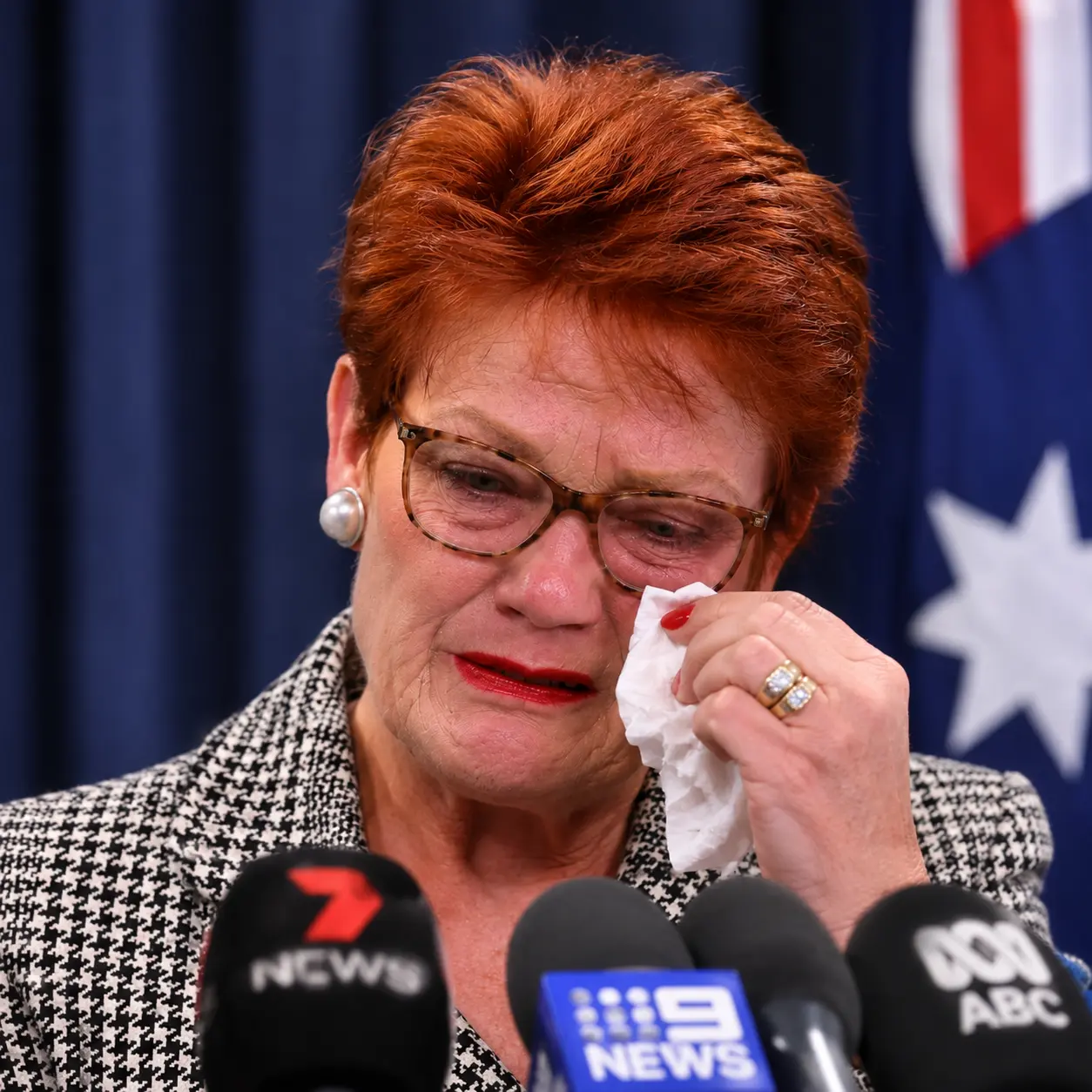
🚨 BREAKING NEWS IN AUSTRALIA: PAULINE HANSON'S POLITICAL POSITION DRAWS RENEWED ATTENTION — WHAT HER ROLE MEANS FOR THE COUNTRY'S FUTURE
AUSTRALIA — Australian Senator and One Nation leader Pauline Hanson remains a prominent figure in the country's political landscape, with her position in the Senate, leadership of One Nation, and longstanding involvement in national debates continuing to attract attention. While dramatic headlines circulating online may suggest that a major announcement was confirmed only 30 minutes ago, no specific new appointment, resignation, or extraordinary political development has been established by the information available for this article. What is clear is that Hanson continues to occupy an important place in Australian parliamentary politics, where debates surrounding immigration, national identity, economic pressures, regional communities, and political representation remain central to public discussion. Her political career has unfolded across several decades, marked by electoral victories, setbacks, controversies, and a sustained ability to generate public debate. For supporters, Hanson represents a political voice willing to challenge established parties and raise issues they believe have been overlooked. For critics, some of her statements and policy positions have raised serious concerns about social cohesion, minority communities, and the direction of public debate. Those competing perspectives have followed her throughout her career and help explain why her political activities continue to receive considerable attention.
Hanson's present standing is documented in official parliamentary records. The Australian Parliament identifies her as a senator representing Queensland and as Leader of One Nation. Its biographical record confirms that she first entered the federal House of Representatives in 1996, lost her seat at the 1998 election, returned to federal Parliament through the Senate in 2016, and was re-elected in 2022. The same record identifies January 28, 2026, as the date on which her current leadership designation, Leader of One Nation, began. This is an important distinction: the documented leadership title is real, but it does not establish that she received a new position within the past half hour. Indeed, the Senate's official notice paper dated November 16, 2026, continues to identify Hanson as One Nation's leader in parliamentary business. These records provide a reliable foundation for understanding her current role, without requiring speculation about an unannounced political event.
Parliament of Australia+1
Her position is significant because Australia's parliamentary system gives senators responsibilities extending beyond the ordinary public exchanges that often dominate political news. Senators scrutinize proposed legislation, participate in committee work, question government decisions, examine public expenditure, and contribute to national debates. Although a senator does not automatically possess executive authority, the Senate can play a consequential role in determining whether legislation passes, is amended, or encounters opposition. For a party leader such as Hanson, parliamentary responsibilities operate alongside the demands of political leadership: communicating policy priorities, coordinating with colleagues, representing party supporters, and explaining the party's positions to voters. The influence of a minor party depends on parliamentary numbers, the issues under consideration, and whether its votes are needed to support or oppose particular measures. That makes the relationship between political visibility and legislative power especially important. A politician may receive widespread media attention without controlling government policy, while a comparatively small parliamentary group can sometimes play an important role in negotiations. Understanding this difference is essential when interpreting dramatic claims about a political leader's influence.The story of Pauline Hanson's political career begins well before her present Senate responsibilities. Born in Brisbane in 1954, Hanson worked in small business and served on Ipswich City Council before entering federal politics. Her election to the House of Representatives in 1996 introduced her to a national audience during a period when Australia was debating economic reform, immigration, globalization, and changes affecting regional and working-class communities. Her political message emphasized concerns about national identity, government priorities, and the perceived distance between established political institutions and some voters. Those themes became associated with the political movement that developed around her. In 1997, she became closely identified with One Nation, which positioned itself as an alternative to the country's established political parties. The movement attracted supporters who believed conventional political organizations were not adequately addressing their concerns, but it also generated criticism over rhetoric and policy positions relating to immigration, multiculturalism, and minority groups. These disagreements were not merely matters of political presentation; they reflected competing ideas about the responsibilities of democratic government, equal treatment, national belonging, and the balance between majority preferences and minority rights. Her electoral defeat in 1998 did not end her public career. Over subsequent years, Hanson remained involved in politics, before eventually returning to the federal Parliament as a Queensland senator in 2016. That return demonstrated the persistence of the political constituency she had cultivated and the continuing relevance of the issues with which her name had become associated. It also marked a transition from a political figure known primarily for her earlier House of Representatives career to a party leader working within the Senate's legislative environment.
The Senate is a particularly important institution in Australia's federal system because it represents states and territories while also serving as a chamber of legislative review. Queensland, the state Hanson represents, includes major metropolitan communities, rapidly growing suburban areas, regional cities, agricultural districts, and remote communities with differing economic and social priorities. A senator elected from Queensland therefore represents a geographically and socially diverse population, not simply the voters who supported that senator's party. Questions involving housing affordability, transport infrastructure, employment, healthcare access, agriculture, energy, and the cost of living can affect Queensland communities in different ways. Some concerns are shared nationally, while others arise from regional conditions. For example, economic pressures facing a family in Brisbane may differ substantially from those confronting a farming household or a small business in a remote town. These differences help explain why political parties devote attention to both broad national messages and specific regional priorities. For Hanson and One Nation, the challenge is to translate political positions into parliamentary proposals, scrutiny of government decisions, and engagement with constituents. Public recognition can bring attention to a party's message, but it does not eliminate the practical requirements of lawmaking. Parliamentary debate involves formal procedures, legal wording, competing amendments, and decisions that can have consequences beyond the immediate political argument. A leader must therefore operate in two environments at once: the public arena, where messages are communicated through interviews, speeches, and digital media, and the parliamentary arena, where those messages encounter institutional rules and the positions of other elected representatives.
Immigration has long been one of the subjects most closely associated with Hanson's political identity. In Australia, immigration policy involves numerous considerations, including workforce needs, family reunification, humanitarian commitments, population growth, housing capacity, infrastructure, and social integration. Different political parties emphasize different aspects of these questions. One Nation has generally advocated a more restrictive approach to immigration and has argued for stronger emphasis on national identity and border controls. Supporters of such policies often cite concerns about population pressures, public services, and the capacity of governments to manage change. Critics argue that restrictive proposals and rhetoric directed toward particular communities can undermine social inclusion and overlook the economic and cultural contributions of migrants. Assessing these competing arguments requires more than slogans. The effects of migration vary across industries, regions, time periods, and different categories of arrivals. Population growth can increase demand for housing and services, while migrants also participate in construction, healthcare, education, business creation, and other areas of the economy. Housing shortages, meanwhile, can reflect multiple factors, including construction capacity, land-use regulation, financing conditions, infrastructure investment, and demographic change. A serious discussion must therefore distinguish the contribution of migration to demand from the broader structural factors affecting supply. This complexity does not prevent political disagreement, but it does make careful evidence particularly important. Hanson remains associated with a political approach that places immigration and national identity near the center of public discussion, and the response to that approach continues to reveal differences in how Australians understand national priorities.
Economic questions form another major part of the environment in which One Nation operates. Cost-of-living pressures can influence political debate because they affect everyday decisions about groceries, housing, transport, electricity, and household savings. For many voters, economic conditions are experienced through practical circumstances rather than national statistics alone. A headline inflation figure may indicate a change in the overall pace of price increases, but it does not necessarily mean that households are paying less for essential goods. Similarly, wage growth can improve purchasing power under some conditions while leaving other households under pressure. Interest rates can affect mortgage holders, renters, businesses, and savers differently. Governments must consider these competing effects when developing economic policy. Opposition parties and minor parties may respond by proposing alternatives, criticizing government priorities, or demanding further scrutiny of spending and regulation. Hanson has frequently positioned her political movement as a voice for Australians who believe their economic concerns receive insufficient attention from major parties. That claim is part of One Nation's political message rather than an independently established description of every voter it seeks to represent. Other parties also propose measures addressing affordability, employment, infrastructure, and regional development, often with different policy designs and assumptions. The relevant question for parliamentary scrutiny is how particular proposals would operate, who would benefit, how they would be funded, and what consequences might follow. For voters seeking to understand Hanson's political role, these practical questions provide a more meaningful basis for evaluation than an unsupported announcement suggesting that a sudden transformation has occurred.
The structure of Australia's political system also matters when considering claims about Hanson's authority. The prime minister leads the federal government, while ministers are responsible for designated portfolios and government administration. Senators can serve as ministers, but holding a Senate seat or leading a minor party does not itself confer ministerial office. Official parliamentary information identifies Anthony Albanese as Australia's prime minister and Hanson as Leader of One Nation, demonstrating the distinction between the country's executive leadership and her party position.
Parliamentary Education Office+1
This distinction is particularly important when social media headlines use expressions such as confirmed, appointed, promoted, or taking control without identifying the office involved. A formal appointment ordinarily has a recognizable institutional basis, such as an announcement by the relevant authority, a parliamentary record, or an official party statement. Leadership changes within political parties likewise require confirmation from the organization concerned. Without such evidence, readers cannot determine whether a headline describes a genuine new development, an existing position, a proposal, or speculation. In Hanson's case, the documented facts are substantial enough to support a detailed political report without inventing an additional event. Her Senate membership and party leadership are established; a new announcement allegedly made 30 minutes ago is a separate claim requiring separate evidence.One Nation's parliamentary presence also illustrates the broader role of smaller parties in Australian democracy. Australia's electoral arrangements allow parties outside the two traditional major political groupings to obtain representation, particularly in the Senate. This creates opportunities for different political perspectives to participate in legislative debate. It can also make negotiations more complicated, because the government may need support from parties or independent senators to pass particular measures. The significance of those negotiations depends on the composition of the chamber and the position taken by each parliamentary group. A party leader's ability to influence a bill therefore cannot be measured simply by media prominence or the intensity of public reaction. It must be considered in relation to the actual votes required, the proposed legislation, and the willingness of other senators to cooperate. Parliamentary records dated November 16 identify Hanson among party leaders involved in procedural notices concerning Senate business. Such references demonstrate her continuing formal participation in the institution, but they should not be confused with evidence of a newly granted executive office.
Monday to Wednesday+1
Parliamentary procedure may appear technical compared with a dramatic televised exchange, yet it shapes how legislation is considered, how questions are put to ministers, and how debates proceed. For politicians who seek to challenge government decisions, knowledge of these procedures can be as important as public speaking. For the public, understanding the procedural context helps distinguish a political announcement from a routine parliamentary development.Hanson's career has also been shaped by the changing relationship between politics and media. When she first entered federal politics, newspapers, radio, and television played a dominant role in bringing political messages to the public. Today, online video, social networks, short clips, and rapidly shared headlines allow statements to circulate far beyond their original audience. This environment can benefit political figures whose messages are direct, memorable, or controversial. It can also make accurate interpretation more difficult. A brief clip may omit the question that prompted a response, the qualifications attached to a statement, or the wider parliamentary debate. A headline may describe an old speech as though it occurred that morning. An image from a previous event may be presented alongside an unrelated claim. These practices are not unique to reporting about Hanson, but they are especially relevant when an established political figure becomes the subject of urgent online speculation. The words just confirmed can create a sense of certainty even when no confirming document is supplied. Likewise, a reference to a development occurring 30 minutes ago may create urgency without establishing the time or location of an actual event. Responsible political reporting requires the underlying evidence to support both the claim and its timing. A verified announcement should identify what happened, who confirmed it, when it occurred, and why it matters. When those elements are absent, the more accurate approach is to explain what is known and what remains unverified.
Public debate surrounding Hanson is unlikely to be understood through a single political issue. Her career has intersected with broader disagreements over immigration, multiculturalism, national identity, government accountability, economic opportunity, and the role of established institutions. Supporters and opponents often interpret the same political statements differently because they place different emphasis on national priorities, social obligations, and the effects of government policy. Some supporters view her willingness to challenge conventional political language as a form of representation. Critics contend that certain arguments can contribute to exclusion or reinforce negative perceptions of minority groups. These perspectives can be examined through the specific statements, proposals, and parliamentary actions involved, rather than treated as interchangeable judgments about her entire career. Democratic accountability depends on allowing politicians to present their positions while also permitting those positions to be challenged through evidence, public discussion, and elections. The same principle applies to political reporting. An article should not transform disagreement into an invented crisis, nor should it present speculation as a confirmed event merely because a dramatic description may attract attention. Political developments deserve scrutiny in proportion to their actual significance, and that significance becomes clearer when readers understand both the institutional facts and the wider policy context.
The future of One Nation will depend on factors extending beyond the public profile of its leader. Political organizations must maintain internal structures, select candidates, develop policy platforms, communicate with voters, and participate in electoral contests. Parliamentary representation creates opportunities for scrutiny and debate, but electoral support can change as public concerns and political circumstances evolve. Issues such as housing affordability, economic security, energy policy, healthcare access, and immigration may remain prominent, although the relative importance of each issue will vary among voters and over time. One Nation's positions will continue to be assessed alongside those of the government, the major opposition parties, the Greens, other minor parties, and independent representatives. No single policy issue or public controversy can establish how future elections will unfold. The relevant evidence will come from documented political activity, public policy decisions, election results, and other reliable measures of public opinion. For Hanson personally, her existing parliamentary responsibilities provide an established platform from which to participate in these debates. Her current Senate term is listed as expiring on June 30, 2028, according to official parliamentary records, although that date should not be interpreted as evidence of any particular future electoral outcome.
Parliament of Australia+1
Ultimately, the central development that can be confirmed is straightforward: Pauline Hanson continues to serve as a Queensland senator and Leader of One Nation, with her political activities remaining part of Australia's national parliamentary debate. Her long career provides ample material for examination, from her initial election in 1996 and return to the Senate in 2016 to her continuing leadership responsibilities in 2026. The official record also shows why precise language matters. Being the leader of a political party is not the same as becoming prime minister, joining the federal cabinet, or receiving a newly created government position. Each would represent a different political event and would require independent confirmation. As Australians follow political developments, distinguishing these roles is essential to understanding who holds authority, how decisions are made, and what particular announcements actually change. Hanson's prominence ensures that her statements and parliamentary actions can attract attention, but prominence alone does not establish that an extraordinary event has taken place. The unanswered question in any claim of a sudden announcement is not whether she remains politically active; official sources confirm that she does. The question is whether a specific new decision has occurred and whether an authoritative source has documented it. Until that evidence is available, a headline claiming an appointment or confirmation within the past 30 minutes remains unverified. What can be stated with confidence is that Hanson remains an elected federal representative and party leader whose political positions continue to form part of Australia's public debate. For readers seeking to understand the country's political landscape, that verified reality offers a firmer foundation than speculation about an announcement whose details have not been established.