🚨 15 MINUTES AGO: “I Can’t Stay Silent About This Anymore…” Dak Prescott Stuns Cowboys Fans With a Behind-the-Scenes Revelation—and His Next Words Raise Questions About His Future
Dak Prescott has spent years accepting nearly every responsibility attached to being the quarterback of the Dallas Cowboys. He has absorbed criticism after painful defeats, defended teammates during difficult stretches, and repeatedly promised that the organization remained capable of reaching its championship goals. During an unexpected and emotional appearance, however, Prescott finally revealed that the pressure behind the scenes had become much heavier than fans realized.
“I can’t stay silent about this anymore,” Prescott began, briefly looking down before continuing. “People see what happens on Sundays, but they don’t see the conversations, the physical cost, or the nights when you question whether giving everything will ever be enough.”
His words immediately stunned the Dallas fan base. Prescott did not announce his retirement or request to leave the Cowboys, but he admitted that private discussions about his health, role, and long-term future had intensified. His next statement created even more uncertainty: “I love this team, but love cannot mean carrying everything alone.”
The media session was originally expected to focus on football strategy. Reporters arrived prepared to ask Prescott about the offense, his connection with CeeDee Lamb, and Dallas’ preparations for another important game.
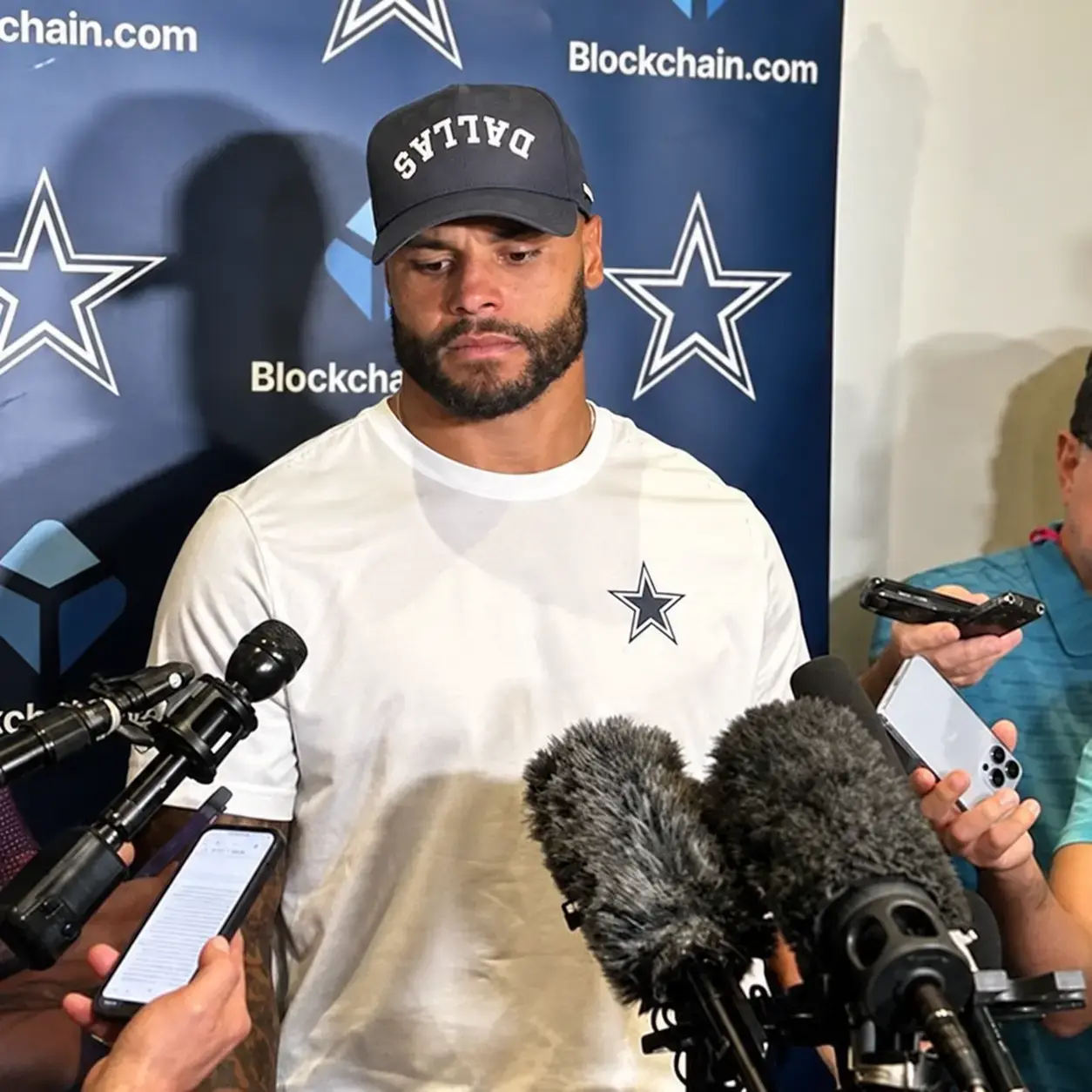
Instead, Prescott entered the room without his familiar confident smile. He sat down slowly, adjusted the microphone, and remained quiet for several seconds as photographers captured every movement.
Prescott began by thanking Cowboys supporters who had defended him throughout the most difficult periods of his career. He acknowledged that playing quarterback in Dallas brought unusual attention and said he had always considered that attention part of the responsibility he accepted.
However, he also admitted that the constant scrutiny had affected him in ways he rarely discussed. Every incomplete pass became a national debate, every interception created questions about his leadership, and every playoff disappointment was treated as proof that he alone had failed the organization.
Prescott said he had spent years trying to prevent that pressure from reaching his teammates. When the Cowboys lost, he stood at the podium and accepted the criticism. When they won, he redirected praise toward the offensive line, coaches, receivers, and defense.
That approach earned respect inside the locker room, but it also created a dangerous expectation. People began assuming that Prescott could absorb unlimited criticism without suffering any emotional consequences.
“There is a difference between accountability and becoming the answer for every problem,” Prescott explained. “I will always own my mistakes, but no quarterback wins or loses alone.”
The statement immediately sparked discussion because Prescott had often refused to publicly criticize the organization. Even during seasons marked by injuries, coaching changes, and inconsistent performances around him, he maintained that the Cowboys possessed everything required to succeed.
This time, he appeared unwilling to repeat the same carefully rehearsed message. Prescott did not accuse any teammate or executive of mistreatment, but he openly questioned whether the expectations placed on him had remained realistic.
He described private meetings in which discussions about the offense repeatedly ended with the same conclusion: Prescott needed to create more, correct more, and carry more. The quarterback accepted those demands because he believed leadership required sacrifice.
Over time, however, the responsibility reportedly became overwhelming. Prescott began feeling that every problem eventually arrived at his locker, regardless of where it originated.
“If protection breaks down, the quarterback has to solve it,” he said. “If the timing is wrong, the quarterback has to repair it. If the game gets away from us, the quarterback is expected to become a miracle worker.”
Prescott emphasized that he welcomed responsibility but wanted the organization to recognize the difference between leadership and isolation. He needed teammates, coaches, and executives to share the weight of expectations rather than allowing one position to become the target for every disappointment.
The quarterback also addressed the physical cost of his career. Prescott had played through pain, endured demanding rehabilitation, and returned from injuries that forced him to rebuild both his body and confidence.
He admitted that being medically cleared did not always mean he felt completely healthy. There were mornings when old injuries created stiffness and practices when every movement required extra preparation.
“Fans see you run onto the field and assume everything is back to normal,” Prescott said. “Sometimes you are competing while knowing normal may never feel exactly the same again.”
His comments forced listeners to reconsider the sacrifices hidden beneath his public confidence. Prescott rarely used injuries as an excuse, but that refusal may have prevented fans from understanding how much effort was required simply to remain available.
The most emotional part of the interview came when he discussed his family. Prescott admitted that football pressure sometimes followed him home, making it difficult to separate the quarterback from the person his loved ones needed.
Sarah Jane Ramos reportedly encouraged him to speak honestly about what he had been carrying. She reminded him that protecting his mental and physical health was not an act of weakness and that his value could never be determined entirely by wins, statistics, or public approval.
“She told me that the people who truly love me do not need me to prove something every Sunday,” Prescott recalled. “They need me healthy, present, and honest.”


That conversation reportedly changed the way Prescott viewed his future. He had always imagined remaining connected to Dallas for the defining years of his career, but he began asking whether loyalty could survive without meaningful support and clear communication.
Prescott insisted that he was not threatening the Cowboys. He had not demanded a trade, issued an ultimatum, or established a deadline. Nevertheless, he made clear that his commitment could no longer be treated as permission to ignore his concerns.
“I have given this organization everything I know how to give,” he said. “All I’m asking is that honesty matters as much when the conversation is uncomfortable as it does when we are celebrating.”
The statement placed immediate pressure on the Cowboys’ leadership. Supporters began asking whether Prescott had lost confidence in the organization’s direction and whether private disagreements had developed over the team’s long-term strategy.
Head coach Brian Schottenheimer reportedly spoke with Prescott before the media appearance. The coach understood that the quarterback had been carrying frustration but did not expect him to discuss the situation so directly.
Schottenheimer was said to respect Prescott’s honesty and viewed the statement as an opportunity rather than an attack. He believed the Cowboys needed stronger communication, particularly when discussing offensive responsibilities and the physical demands placed on their quarterback.
Prescott also addressed his relationship with CeeDee Lamb. He praised the receiver’s competitiveness and insisted there was no private conflict between them, despite speculation created by emotional moments during games.
The quarterback explained that frustration between teammates did not automatically mean their relationship was damaged. Competitive players sometimes disagreed because both cared deeply about winning.
“CeeDee wants the ball because he believes he can change the game, and I want that confidence from him,” Prescott said. “The important thing is that we communicate instead of allowing outside voices to define what is happening between us.”
Prescott’s defense of Lamb reinforced his larger message. Even while discussing his own burden, he refused to shift blame toward another player. His concern centered on the structure surrounding the team rather than the character of individual teammates.
The most unsettling moment arrived when a reporter asked whether Prescott could guarantee that he would finish his career with the Cowboys. He remained silent for several seconds, took a slow breath, and offered an answer that immediately spread across social media.
“My heart has always been in Dallas,” Prescott said. “But I cannot promise how a story ends while we are still deciding what the next chapter should look like.”
The response stopped short of confirming a departure, yet it represented a dramatic change in tone. Prescott had often spoken confidently about his connection to the Cowboys, but he now appeared unwilling to make a promise that depended on decisions outside his control.
Fans reacted with a mixture of fear, anger, and support. Some demanded that the organization repair its relationship with Prescott immediately, while others argued that the quarterback’s performance should remain the only relevant issue.
Many supporters defended him, pointing out that years of criticism had often reduced complicated team failures to a single name. They argued that Prescott had earned the right to ask whether Dallas was providing the stability and support required to compete for a championship.
Prescott acknowledged that criticism came with the position. He did not ask fans to ignore mistakes or avoid difficult questions. Instead, he asked for a more honest conversation about what quarterbacks could and could not control.
He also revealed that thoughts about life after football had become more frequent. Prescott did not suggest that retirement was imminent, but injuries and family responsibilities had changed his understanding of how quickly an NFL career could end.
“When you are young, you believe there will always be another season,” he explained. “Then you experience enough injuries and watch enough teammates leave, and you realize nothing about this game is guaranteed.”
The realization had made Prescott more protective of his time and health. He still wanted to pursue a championship, but he no longer believed that ambition required ignoring every warning from his body or accepting responsibility for decisions he did not make.
Prescott said he wanted the final stage of his career to represent more than survival. He wanted to play in a system built around trust, preparation, and shared accountability.
The Cowboys could provide that environment, he insisted, but the organization needed to confront its problems honestly. Reputation, financial value, and national attention could not substitute for internal stability.
“I do not want promises made for cameras,” Prescott said. “I want conversations that remain honest when the doors close.”
His words suggested that important meetings would follow. Coaches and executives now needed to determine whether Prescott’s concerns could be addressed before uncertainty began affecting the locker room.
Teammates reportedly contacted him immediately after the appearance. Several thanked him for expressing pressures that other players felt but lacked the platform to discuss.
That reaction showed why Prescott remained central to the Cowboys beyond his position. He had become one of the locker room’s most important voices, trusted not because he avoided difficulty but because he repeatedly stood in front of it.
As the interview approached its conclusion, Prescott was asked what Cowboys fans should believe about his immediate future. He looked directly into the camera and spoke slowly.
“I am still here, and I am still fighting,” he said. “But fighting for this team also means telling the truth about what must change.”
Prescott then thanked the reporters and left without accepting additional questions. There was no retirement announcement, trade request, or emotional farewell. Yet the future suddenly felt less certain than it had before he entered the room.
For Dallas, the message could not be ignored. Prescott had spent years carrying the expectations attached to America’s most scrutinized football team, but he was no longer willing to pretend that the burden had no cost.
The Cowboys now face a defining decision. They can dismiss his statement as temporary frustration, or they can recognize it as a warning from a quarterback who still wants to believe in the organization.
Prescott began with the words, “I can’t stay silent about this anymore.” By the time he walked away, one question followed him out of the room: if Dallas cannot give its quarterback the support and honesty he is demanding, where will the next chapter of his career be written?