An Unexpected Confrontation, a Moment of Uncomfortable Silence, and a Powerful Message About Faith, Leadership, and the Price of Political Division
VATICAN CITY — The atmosphere inside an imagined Vatican press gathering was initially calm as Pope Leo XIV prepared to address journalists about peace, human dignity, and the responsibilities of religious leadership in an increasingly divided world. But what began as a thoughtful conversation suddenly took an unexpected turn when a reporter raised a provocative question involving U.S. President Donald Trump and the tensions between political power and moral authority.
The room had been filled with anticipation as reporters gathered to hear the pontiff discuss the importance of compassion during a period of international uncertainty. Pope Leo XIV, known for his measured public manner, listened attentively as journalists asked about humanitarian concerns, global conflicts, and the role of the Catholic Church in encouraging dialogue.
Then one journalist stood and introduced a question that immediately changed the atmosphere.
"Your Holiness, President Trump has been sharply critical of religious leaders who challenge his political positions. How do you respond when powerful political figures appear to dismiss the moral concerns raised by the Church?"
The question was framed around an imagined political confrontation rather than a verified exchange of remarks.
For several seconds, the pontiff remained silent.
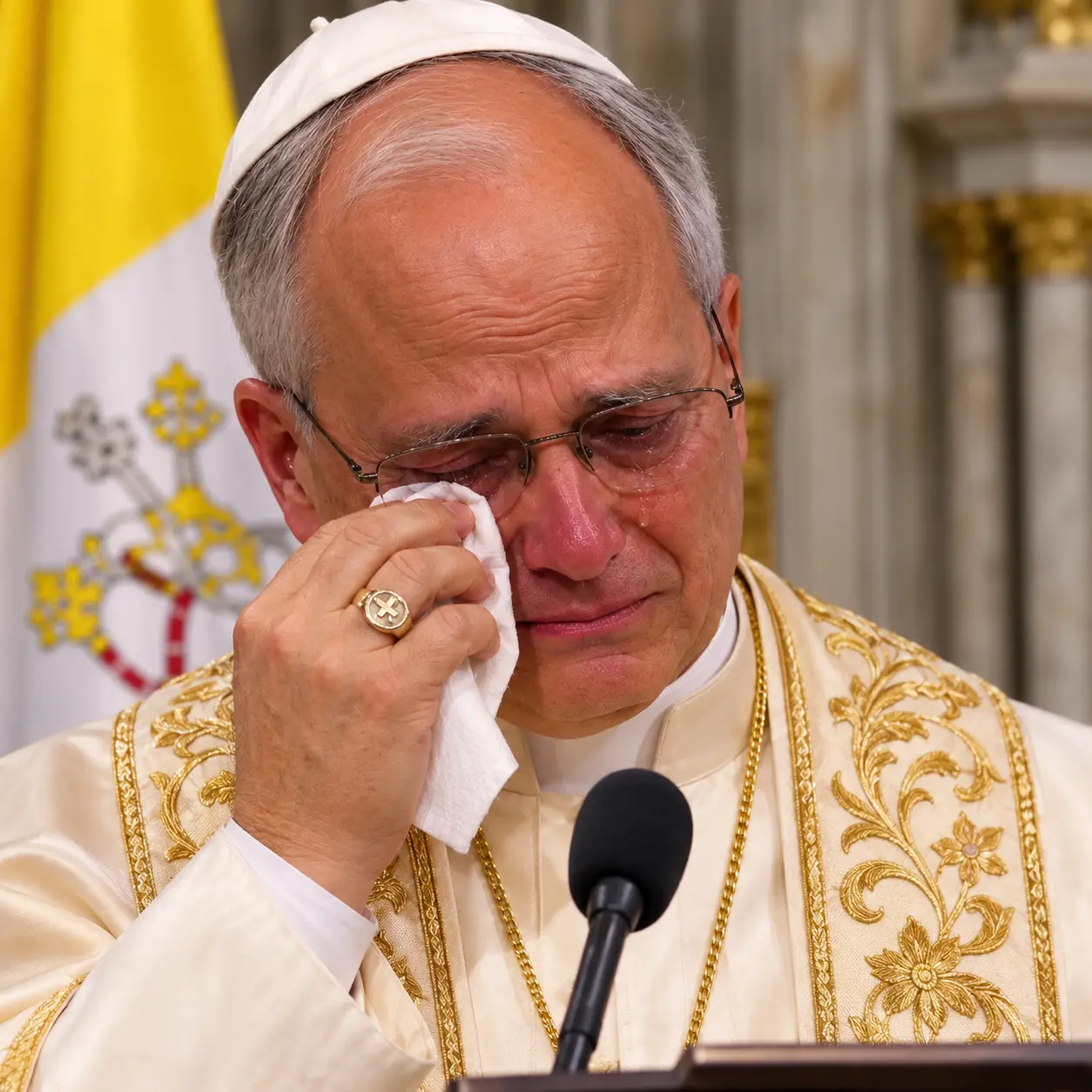
He looked toward the journalist, then briefly lowered his eyes as though considering the implications of the question.
When he finally spoke, his answer was far more personal than anyone expected.
 A Historic Papacy Under the World's Spotlight
Pope Leo XIV, born Robert Francis Prevost, became the leader of the Roman Catholic Church in May 2025, marking a historic moment as the first pope born in the United States. His election attracted worldwide attention, with observers examining how his American background and years of international religious service might influence his approach to the challenges facing the Church.
His experiences in the United States and Peru contributed to a perspective shaped by different communities, cultures, and social realities. Throughout his religious career, themes of service, pastoral responsibility, and the importance of human dignity have played a central role in his public identity.
As pope, his words carry enormous significance for Catholics around the world, while his statements on moral and humanitarian issues also attract attention from political leaders and international commentators.
That position creates a delicate responsibility: offering moral guidance without reducing the Church's mission to the priorities of any political party or government.
In this imagined Vatican encounter, that tension becomes the center of an extraordinary exchange.
The Question That Changes Everything
After listening to the journalist, Pope Leo XIV begins his response by emphasizing that the Church's responsibility is not to compete with political leaders for influence, but to defend the dignity of every human being.
"The mission of the Church is not to win political arguments," he says in this imagined scene. "It is to remind the world that every person possesses a dignity that cannot be measured by wealth, nationality, or political allegiance."
The audience remains attentive as he continues.
He explains that political disagreement is inevitable in democratic societies and that religious leaders should not be surprised when their moral teachings challenge powerful institutions.
However, he also warns against allowing disagreement to become a source of personal hostility.
"We must learn to disagree without forgetting the humanity of the person standing before us," he says. "When anger becomes more important than understanding, everyone loses something valuable."
The response initially appears to satisfy the room.
But the journalist asks a follow-up question.
And this time, the tone becomes noticeably sharper.

"Are You Afraid to Confront President Trump?"
The reporter asks whether the pontiff is reluctant to criticize Trump directly, suggesting that a refusal to engage in personal confrontation could be interpreted as political weakness.
A murmur spreads through the imagined gathering.
Pope Leo XIV pauses, his expression becoming more serious.
"Do you believe that compassion is weakness?" he asks.
The journalist hesitates before explaining that political leaders often respond more forcefully to direct criticism than to general appeals for unity.
The pontiff listens carefully, then offers a different perspective.
"Strength is not always demonstrated by the volume of our voices," he replies. "Sometimes strength means refusing to allow anger to determine our actions."
He acknowledges that religious leaders have a responsibility to speak clearly when human dignity is threatened, but he distinguishes moral criticism from personal hostility.
"To defend the vulnerable is a duty," he says. "To humiliate another person is not."
The words create a thoughtful silence throughout the room.
Yet the most unexpected moment is still to come.
The Moment Pope Leo XIV Decides to Walk Away
As the press gathering approaches its conclusion, another question attempts to draw the pontiff into a direct comparison between his moral authority and Trump's political influence.
Rather than responding immediately, Pope Leo XIV looks toward the assembled journalists.
He explains that he has already addressed the importance of compassion, responsibility, and respectful disagreement, and that continuing to frame the conversation as a personal contest between religious and political leaders would distract from the people whose needs deserve attention.
"I did not come here to speak about who is more powerful," he says. "I came here to speak about those who feel powerless."
The room falls silent.
He continues by describing families affected by conflict, communities struggling with poverty, and people whose suffering receives little attention because their stories do not generate dramatic headlines.
"While we argue about the words of powerful men, there are children who need food, families who need shelter, and people who need peace."
His voice remains steady, but the emotional significance of the statement is unmistakable.
Then he gently closes the folder resting before him.
"Perhaps we should spend more time listening to them."
With those words, the pontiff rises from his chair and prepares to leave the gathering.
A Silence More Powerful Than an Argument
In the imagined scene, the journalists appear surprised by the sudden conclusion of the conversation. Some exchange glances, while others continue writing notes as the pope walks toward the exit.
There is no shouting, no dramatic confrontation, and no personal insult directed at the American president.
Instead, Pope Leo XIV's departure becomes a symbolic rejection of the expectation that every political disagreement must end with a public battle.
Before reaching the doorway, he turns back toward the room.
"Peace begins when we remember that the person we disagree with is still our neighbor," he says.
The statement leaves the assembled journalists reflecting on the difference between defending moral principles and turning disagreement into spectacle.
For the imagined audience, the moment raises an uncomfortable question about modern political culture: whether public discussions have become so focused on confrontation that thoughtful responses are sometimes mistaken for weakness.
A Wider Debate About Faith and Political Power
In the imagined aftermath, the encounter becomes the subject of discussion among religious commentators, political observers, and people interested in the relationship between faith and government.
Some interpret the pope's departure as a powerful reminder that religious leadership should remain independent of partisan conflict.
Others argue that religious figures must sometimes address political leaders directly, particularly when public policies raise serious ethical or humanitarian concerns.
A third perspective suggests that both approaches can be necessary, depending on the circumstances: moral clarity may require direct criticism, while effective dialogue also depends on restraint and mutual respect.
The competing interpretations highlight a longstanding challenge for religious institutions operating in politically divided societies.
How can spiritual leaders defend moral principles without allowing their message to become defined entirely by partisan conflict?
And how can political leaders engage with religious criticism without treating every disagreement as a personal attack?
In this imagined encounter, Pope Leo XIV does not offer a simple solution.
Instead, he asks the public to consider what may be lost when the desire to defeat an opponent becomes more important than the pursuit of understanding.

The Final Message That Changes the Meaning of the Encounter
Later that evening, in the imagined story, a Vatican aide asks the pontiff whether he regrets ending the press gathering so abruptly.
Pope Leo XIV reflects on the question before answering.
"I do not regret refusing to make another person the enemy," he says. "But I hope people understood why I wanted the conversation to return to those who are suffering."
The aide asks whether the public might interpret his decision as an unwillingness to answer difficult questions.
The pontiff smiles gently.
"Difficult questions deserve honest answers," he replies. "But not every question deserves to become a quarrel."
His words offer a final reflection on the responsibilities of leadership, suggesting that courage may sometimes involve refusing to participate in a confrontation designed primarily to create division.
The imagined episode ends without a dramatic victory for either political or religious authority.
Instead, it leaves a message about the importance of compassion, thoughtful disagreement, and the recognition that moral leadership is measured by more than the ability to dominate a public exchange.
Because sometimes the most powerful response is not the argument that silences an opponent — but the decision to remind everyone why the conversation mattered in the first place. 🕊️❤️