The following is an invented political drama. The television confrontation, accusations, documents, border security proposal, grieving mother's letter, and dialogue are fictional. They are not verified events or allegations involving either senator.
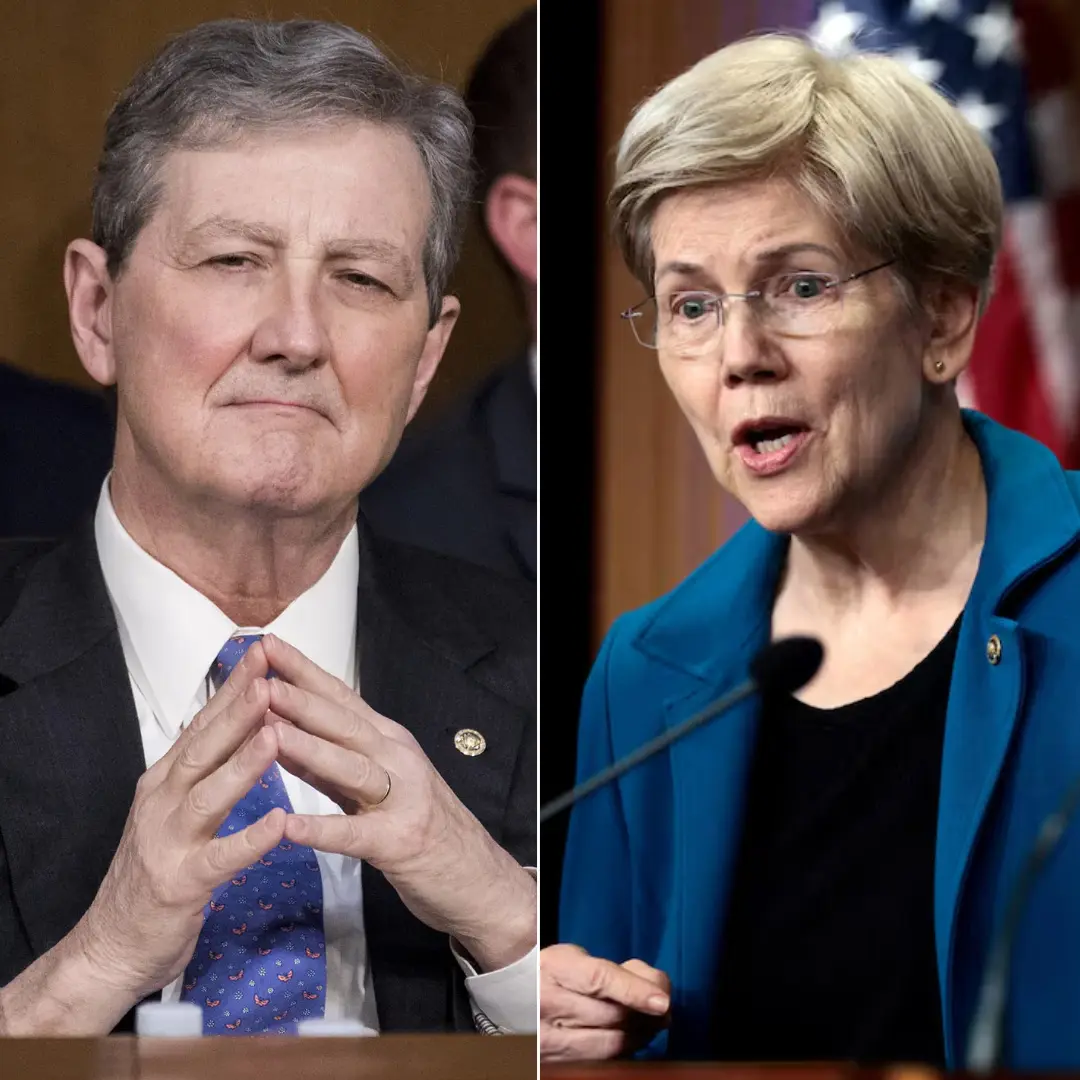
An ordinary morning television broadcast in Washington, D.C., transforms into an extraordinary political confrontation when Senator Elizabeth Warren and Senator John Neely Kennedy become involved in an unexpected exchange that leaves the fictional studio completely silent.
The program begins with a discussion about border security, immigration enforcement, humanitarian responsibilities, and the difficult decisions lawmakers face when attempting to balance public safety with the rights of vulnerable families.
Warren appears as a scheduled guest, prepared to discuss her concerns about a fictional border security proposal associated with Kennedy. The conversation initially proceeds calmly, with the hosts asking questions about the legislation's potential consequences.
But the atmosphere changes when one presenter asks whether the proposal represents a meaningful response to public safety concerns or another example of political disagreement overshadowing practical solutions.
Warren leans toward the microphone.
Her expression becomes serious.
In this imagined exchange, she argues that lawmakers should carefully consider how enforcement proposals affect children, families, asylum seekers, and communities living near the border.
She maintains that public safety and humanitarian protections should not be treated as mutually exclusive responsibilities.
The host asks whether she believes Kennedy's proposal achieves that balance.
Warren pauses.
Then she delivers the remark that becomes the emotional turning point of the fictional broadcast.
"This approach is a national disgrace," she declares, criticizing what she portrays as an insufficient consideration of humanitarian consequences.
The studio falls quiet.
One host asks her to explain the criticism.
Warren argues that legislation should be evaluated through its actual provisions, implementation costs, oversight mechanisms, and consequences for people affected by enforcement decisions.
She expresses concern that political rhetoric can sometimes obscure the difficult realities experienced by families seeking safety.
The conversation grows increasingly intense.
Then a producer receives an unexpected message.
Senator John Neely Kennedy, who has supposedly been watching the broadcast from his Washington office, wants to respond directly.
The hosts exchange surprised glances.
After a brief discussion, they agree to connect him to the program.
Within moments, Kennedy's image appears on the studio screen.
He sits behind a wooden desk, surrounded by papers and several carefully arranged folders.
His expression is composed.
The lead host welcomes him and explains that Warren has been discussing concerns about the fictional legislation.
Kennedy nods.
Then he begins speaking.
"Senator Warren has every right to disagree with a proposal," he says in the imagined exchange.
"But disagreement should begin with what the proposal actually says."
The host asks whether he considers Warren's criticism unfair.
Kennedy does not immediately answer.
Instead, he reaches toward the first folder.
He opens it.
Then he places a document on the desk.
"This is the language we're discussing," he says.
The fictional document contains provisions concerning border processing, interagency coordination, child protection procedures, and accountability requirements.
Kennedy argues that the proposal is intended to address weaknesses in administrative systems while establishing clearer responsibilities for agencies involved in border operations.
Warren responds that the existence of written protections does not necessarily guarantee that those protections will work in practice.
She emphasizes that implementation matters.
A law can contain reassuring language while producing unintended consequences if oversight and resources prove inadequate.
Kennedy acknowledges the concern.
Then he opens another folder.
This one contains fictional budget estimates and administrative reports.
He explains that lawmakers must examine whether agencies possess sufficient resources to carry out their responsibilities.
Without adequate staffing, training, and oversight, he argues, even well-intentioned policies can fail.
The host asks whether he is suggesting that Warren has overlooked those issues.
Kennedy responds that the disagreement should be tested against the available evidence rather than reduced to personal descriptions.
Warren challenges him to explain how his proposal would protect vulnerable children while strengthening enforcement.
The conversation becomes more focused.

Kennedy outlines the fictional bill's proposed reporting requirements, procedures for reviewing administrative failures, and mechanisms intended to improve coordination between responsible agencies.
Warren questions whether those measures would be enforceable.
She asks what happens when agencies fail to comply.
Kennedy replies that accountability must include independent review and transparent reporting.
The hosts listen closely.
What began as a heated exchange is becoming a detailed argument about the responsibilities of government.
Then Kennedy reaches for another folder.
The studio camera focuses on the papers.
The host asks what they contain.
Kennedy explains that the fictional documents summarize questions about transparency in nonprofit funding and the importance of examining how public resources are distributed.
He does not present them as proof of wrongdoing by Warren.
Instead, he argues that public officials should support consistent disclosure standards for organizations involved in government-funded programs.
Warren responds that nonprofit oversight is a legitimate subject but should not be used to distract from the specific provisions of border legislation.
She asks whether the documents establish any connection to the proposal under discussion.
Kennedy acknowledges that the subjects are distinct.
He explains that his broader argument concerns transparency, institutional accountability, and the importance of examining claims carefully before reaching conclusions.
The host intervenes.
She reminds both senators that allegations concerning financial misconduct require verified evidence and should not be presented as established facts without proper documentation.
Both participants agree that unsupported accusations should not replace substantive policy discussion.
The exchange continues.
Warren returns to the humanitarian implications of the fictional bill.
She argues that border security measures must be evaluated alongside legal obligations and the practical needs of children and families.
Kennedy responds that administrative failures can also expose vulnerable individuals to serious risks.
He believes stronger procedures and clearer responsibilities can improve both security and humanitarian outcomes.
Neither senator accepts the other's conclusions.
But the debate takes an unexpected emotional turn when Kennedy reaches for a final envelope.
Unlike the earlier folders, it contains no policy tables or financial summaries.
It holds a handwritten letter.
The host notices the change.
"Senator, what is that?" she asks.
Kennedy looks down.
Then he explains that the letter comes from a fictional mother named Carla, whose family experienced a devastating tragedy connected to failures in a public administrative system.
He makes clear that the letter is being used as a hypothetical illustration rather than evidence of an actual case.
The studio grows quiet.
Kennedy unfolds the paper.
He begins reading.
In the fictional letter, Carla describes the ordinary morning when she last saw her child smiling before leaving home.
She remembers preparing breakfast.
She remembers a hurried goodbye.
And she remembers believing that the day would end like countless others.
But it did not.
The imagined mother explains that a series of administrative mistakes, communication failures, and delayed responses contributed to circumstances in which her child died.
The story does not identify an actual victim or assign responsibility to a real person.
Instead, it illustrates the devastating consequences that can follow when institutions fail to carry out their responsibilities.
Kennedy pauses.
His voice becomes quieter.
He continues reading.
Carla describes the difficulty of returning to an empty home.
The silence at the dinner table.
The untouched belongings.
And the overwhelming realization that ordinary routines can become painful reminders of someone who is gone.
The hosts stop interrupting.
Warren listens.
Kennedy reaches the final paragraph.
In the imagined letter, Carla asks lawmakers to remember that policy disagreements affect real human beings.
She does not demand that everyone agree.
She asks only that leaders examine evidence, consider consequences, and work seriously to prevent avoidable tragedies.
Kennedy folds the letter.
For several seconds, he says nothing.
The studio remains silent.
Then he looks toward the camera.
"That is why these conversations matter," he says.
The host asks what he believes the letter demonstrates.
Kennedy responds that legislation should be judged by whether it addresses identifiable problems and protects people from preventable harm.
He argues that public officials have a responsibility to examine administrative weaknesses before those weaknesses contribute to further suffering.
Warren replies that she agrees with the importance of protecting children and preventing avoidable tragedies.
However, she emphasizes that individual stories, while deeply moving, cannot establish whether a particular legislative proposal will achieve its intended results.
She argues that lawmakers must consider broader evidence, legal protections, implementation risks, and the experiences of different affected communities.
Kennedy acknowledges that emotional stories alone cannot settle complex policy disputes.
The host asks whether the two senators have found any common ground.
Warren says that government accountability, child safety, and effective oversight are responsibilities that deserve bipartisan attention.
Kennedy agrees that those objectives should not belong exclusively to one political party.
But significant disagreements remain.
Warren questions whether the fictional proposal contains sufficient safeguards against harmful enforcement practices.
Kennedy maintains that the bill's accountability measures deserve serious consideration.
The exchange is intense, but neither participant abandons the discussion.
Then the host announces that only one minute remains.
She invites Kennedy to offer a final statement.
The fictional senator looks toward the camera.
He does not raise his voice.
Instead, he returns to the central issue of the debate.
"Senator Warren and I can disagree about legislation," he says.
"That's part of our responsibility."
He pauses.
"But if we turn every disagreement into a contest over who can deliver the harshest insult, we risk forgetting the people who need us to solve actual problems."
The studio becomes quiet.
Kennedy continues.
"A mother who loses a child doesn't need a television argument to declare a winner."
He looks down at the letter.
"She needs public officials willing to examine what failed, determine what can be improved, and take responsibility for the decisions they make."
The host watches attentively.
Kennedy adds that government policies should be subjected to rigorous scrutiny, regardless of which party introduces them.
"If my proposal has weaknesses, identify them," he says.
"If the evidence shows a better approach, bring it forward."
Then he delivers the final line of the imagined exchange.
"The people we serve deserve more than our anger. They deserve our attention, our honesty, and our willingness to do the difficult work."
The room falls silent.
For several seconds, the hosts do not speak.
Warren looks toward the monitor.
Then she responds.
"I agree that the people affected by these decisions deserve serious attention," she says.
"But that means we must examine every proposal carefully, including the potential harm it may cause."
The host nods.
The fictional confrontation ends not with a clear political victory, but with an acknowledgment that emotionally charged debates cannot replace careful examination of public policy.
The broadcast moves toward its conclusion.
Kennedy thanks the hosts for allowing him to respond.
Warren reiterates her concerns about the proposed legislation.
And the presenters emphasize the importance of evaluating legislative claims against reliable evidence.
The cameras gradually pull back.
The program transitions to its next segment.
But within the fictional narrative, the exchange continues generating discussion among viewers.
Some are struck by Kennedy's restrained delivery and his emphasis on administrative accountability.
Others focus on Warren's insistence that humanitarian protections and implementation risks require careful consideration.
The imagined debate raises questions that extend beyond the personalities involved.
How should lawmakers balance public safety with individual rights?
What evidence is necessary to determine whether proposed legislation will work?
How can institutions improve accountability without creating additional burdens for vulnerable communities?
And how should elected officials respond when political disagreements become personal?
The fictional story offers no simple answers.
Instead, it illustrates how a confrontational television exchange can reveal competing priorities, overlapping concerns, and unresolved questions about government responsibility.
Both senators enter the imagined discussion with strongly expressed positions.
Both challenge aspects of the other's argument.
And both acknowledge that protecting vulnerable people requires more than memorable television statements.
The emotional centerpiece remains Carla's fictional letter.
Her imagined experience reminds the audience that administrative failures can carry consequences extending far beyond political debate.
But the story also emphasizes that powerful personal narratives must be considered alongside verified evidence.
A heartbreaking example can explain why a problem deserves attention.
It cannot, by itself, prove that one legislative proposal is the correct solution.
That distinction becomes essential to the fictional exchange.
Kennedy's argument focuses on identifying weaknesses and strengthening institutional accountability.
Warren's argument emphasizes examining whether enforcement measures adequately protect rights and avoid unintended harm.
Their disagreement reflects different concerns about how policy should be designed and evaluated.
As the imagined television segment concludes, the hosts return to a final observation.
Political disagreements are inevitable in a democracy.
But productive debate requires more than dramatic accusations.
It requires evidence.
Clear explanations.
Respect for the people affected by policy decisions.
And a willingness to acknowledge uncertainty when complicated questions remain unresolved.
In the final scene, the fictional camera returns briefly to the empty studio chairs.
The microphones have been switched off.

The documents are no longer visible.
And the conversation has ended.
Yet the imagined final statement continues to define the story.
"The people we serve deserve more than our anger. They deserve our attention, our honesty, and our willingness to do the difficult work."
The fictional confrontation between Elizabeth Warren and John Neely Kennedy ultimately becomes a story about the responsibilities of public leadership.
Its dramatic moments attract attention.
Its personal disagreements create tension.
But its central question concerns something more enduring.
Whether elected officials can move beyond political confrontation and focus on evidence, accountability, and the consequences of their decisions.
In this imagined broadcast, the final silence does not establish that one senator has defeated the other.
It reflects the weight of the issues under discussion.
And it leaves viewers with a question that no television confrontation can answer on its own.
When public policy affects real families, will political leaders prioritize winning the argument, or will they commit themselves to examining the evidence and improving the systems people depend upon?
This is a fic