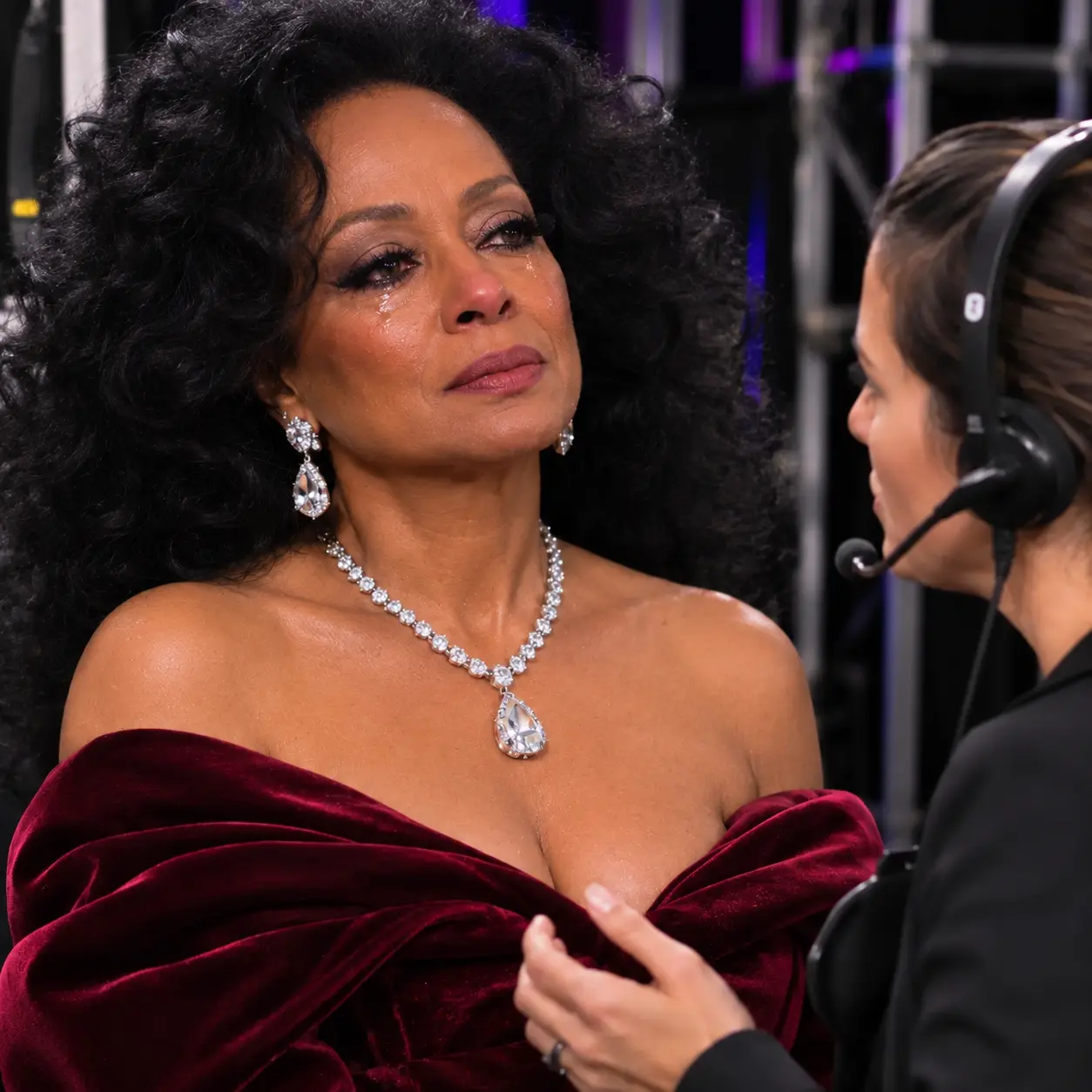
🚨💔 DIANA ROSS'S IMAGINED NEW YORK CONCERT TAKES A HEARTBREAKING TURN — AN UNEXPECTED MEDICAL TEST RESULT, AN EMOTIONAL BACKSTAGE REACTION, AND THE PRIVATE DECISION THAT LEAVES EVERYONE SPEECHLESS! 😳🎤
NEW YORK CITY — Diana Ross has spent more than six decades captivating audiences with her extraordinary voice, timeless elegance, and unforgettable stage presence.
From her legendary years with The Supremes to her remarkable solo career, Ross has become one of the most influential performers in American music history.
But imagine a night when the legendary singer's dazzling performance is interrupted by news she never expected to receive.
Thousands of fans are cheering.
The orchestra is playing.
The stage lights are shining.
And backstage, a member of her fictional team is holding a message that could change the evening.
The message concerns an unexpected medical test result.
Within moments, the atmosphere shifts from celebration to uncertainty.
And when Diana learns what has happened, her emotional reaction leaves those around her struggling to find the right words.
This is an explicitly fictional entertainment scenario. There is no verified evidence that Diana Ross recently received alarming medical test results, experienced a health emergency, or reacted angrily backstage during a New York performance.
The imagined story begins inside a packed concert venue in Manhattan.
The audience has been waiting for hours.
Fans of different generations fill the seats.
Some remember Diana's earliest recordings with The Supremes.
Others discovered her music through their parents or grandparents.
And younger listeners have come to experience the voice behind songs that have become part of American musical history.
As the lights dim, the crowd erupts.
Diana Ross appears beneath a brilliant spotlight.
She wears an elegant, shimmering gown.
Her smile is radiant.
And when the opening notes of a familiar song fill the room, the audience rises to its feet.
For nearly an hour, the fictional performance unfolds beautifully.
Diana moves gracefully across the stage.
She acknowledges fans in the front rows.
And she speaks warmly about the power of music to bring people together.
But behind the curtain, an unexpected situation is developing.
THE MESSAGE THAT CHANGES THE EVENING
In the imagined backstage area, a fictional tour coordinator receives a confidential call from a medical office.
Earlier that week, Diana had participated in a routine health assessment.
A follow-up laboratory report has become available sooner than expected.
The message indicates that one result requires additional review.
It does not establish a diagnosis.
It does not confirm a serious illness.
And it does not mean that Diana is experiencing a medical emergency.
But the medical office recommends that she speak with a qualified clinician to clarify the finding and determine whether further testing is necessary.
The fictional coordinator is uncertain how to proceed.
Diana is performing.
The audience is enthusiastic.
And interrupting the evening could create unnecessary alarm.
After consulting another member of the fictional team, the coordinator decides to wait until the next scheduled break.
When Diana returns backstage between songs, she immediately notices the concerned expressions around her.
In original fictional dialogue, she asks:
“What's happened? Why does everyone look so serious?”
The coordinator hesitates.
Then explains that a medical office has requested a follow-up conversation.
Diana's expression changes.
“Why am I hearing about this now?”
Both statements are invented for this story and are not authenticated quotations.
But within the fictional scenario, the question marks the beginning of a deeply emotional confrontation.
THE ANGRY REACTION THAT STUNS HER TEAM
Diana asks to see the message.
The coordinator hands her the fictional report summary.
She reads it carefully.
Then she looks toward the team.
In imagined dialogue, she says:
“You should have told me there was something I needed to discuss with my doctor.”
A staff member explains that they did not want to interrupt the performance without understanding the result.
Diana shakes her head.
“This is my health. I should be the one deciding when and how I receive information about it.”
The dialogue is fictional.
Her frustration is not portrayed as evidence of a medical crisis.
Instead, it reflects concern about personal autonomy and communication.
The team had intended to protect her from unnecessary worry.
But by delaying the conversation, they created a different problem.
Diana feels excluded from a decision involving her own private information.
For several moments, the room falls silent.
Then she places the report on a nearby table.
Her voice softens.
“I know you were trying to help. But please don't make that choice for me again.”
The words are invented.
Within the imagined scene, the team acknowledges her concerns.
They apologize for the delay.
And they agree that any future medical communication should be handled according to her preferences.
WHAT THE FICTIONAL TEST RESULT ACTUALLY MEANS
The imagined medical message contains one important detail.
A laboratory value falls outside the expected reference range and requires professional interpretation.
That alone does not establish a disease.
Medical test results can vary for many reasons.
Some findings may be temporary.
Others may reflect differences in laboratory methods or individual circumstances.
And some require additional investigation before a clinician can explain their significance.
In this fictional story, no specific diagnosis is given.
No emergency treatment is required.
And the result is not presented as proof of a serious medical condition.
The fictional clinician recommends a private consultation and, if appropriate, a repeat test.
This distinction matters.
A dramatic headline about an unexpected medical result can create the impression that a public figure has received devastating news.
But without a verified medical statement, there is no basis for claiming that Diana Ross has been diagnosed with any condition.
Health information is personal.
And speculation about a celebrity's medical status can cause unnecessary concern among fans and family members.
THE LEGENDARY CAREER BEHIND THE SPOTLIGHT
Diana Ross was born on March 26, 1944, in Detroit, Michigan.
Her extraordinary musical journey began during the rise of Motown.
As the lead singer of The Supremes, she helped create some of the most recognizable recordings of the 1960s.
Songs such as Where Did Our Love Go, Baby Love, Stop! In the Name of Love, and You Can't Hurry Love became defining hits.
The Supremes achieved remarkable commercial success.
Their music helped bring Motown to audiences around the world.
And Diana's distinctive voice became one of the label's most recognizable sounds.
After leaving the group, Ross launched a successful solo career.
Her recordings included Ain't No Mountain High Enough, Touch Me in the Morning, Love Hangover, Upside Down, and I'm Coming Out.
She also expanded into acting.
Her performance as Billie Holiday in Lady Sings the Blues earned her an Academy Award nomination.
Over the decades, Ross became an enduring symbol of musical excellence, glamour, and artistic versatility.
Her influence can be heard in generations of performers.
And her recordings continue reaching audiences long after their original release.
That remarkable history makes the imagined backstage moment emotionally significant.
For an artist whose life has been shaped by performance, the possibility of stepping away from the stage unexpectedly can carry particular weight.
THE MOMENT DIANA CONSIDERS ENDING THE SHOW
Returning to the fictional backstage area, Diana sits quietly.
Her team gives her space.
The orchestra is waiting.
The audience is unaware of the private conversation.
For several minutes, Diana considers what to do.
She could end the performance.
She could continue without addressing the message.
Or she could take a short break while arranging a private consultation.
In original fictional dialogue, she asks:
“Has a doctor said I need immediate medical attention?”
The coordinator responds:
“No. The message asks for a follow-up discussion. We haven't been told that there's an emergency.”
Both statements are invented.
Diana thinks carefully.
She decides that the appropriate next step is to speak directly with a medical professional.
The fictional team arranges a confidential call.
A clinician explains that the result needs clarification but does not, by itself, establish a serious diagnosis.
Diana listens.
She asks questions.
And she agrees to arrange any recommended follow-up evaluation.
The conversation helps reduce the uncertainty.
But it also reinforces her earlier concern.
She wants accurate information.
Not speculation.
And not decisions made on her behalf.
A PRIVATE CONVERSATION ABOUT FEAR AND STRENGTH
After the fictional medical call, Diana remains seated for a few moments.
A longtime fictional colleague approaches.
The colleague asks whether she is all right.
Diana looks toward the stage curtain.
In imagined dialogue, she says:
“People see the lights, the gowns, the music. They don't always see how human you feel when something unexpected happens.”
The statement is invented.
But it captures an important truth about celebrity culture.
Public figures are often expected to appear confident and composed.
Their performances may create the impression that they are untouched by ordinary worries.
Yet fame does not eliminate uncertainty.
And professional success does not remove the need for privacy, support, or accurate information.
Within the imagined scenario, Diana's emotional reaction is not a sign of weakness.
It is a response to uncertainty and a reminder that even celebrated performers deserve control over their personal decisions.
THE DECISION THAT SURPRISES EVERYONE
The fictional concert coordinator asks whether Diana wants to cancel the remainder of the performance.
She pauses.
Then she asks for a few minutes to consider the options.
After speaking with the clinician and confirming that no immediate emergency has been identified, she decides to return to the stage.
The choice is specific to this imagined scenario and should not be treated as medical advice.
In real situations, whether someone should continue performing or working after an unexpected test result depends on their symptoms, clinical circumstances, and professional medical guidance.
For the fictional Diana, the immediate issue has been clarified enough to allow the evening to continue.
But she makes one request.
The team must respect her privacy.
No details about the test result should be shared with the audience or the media.
And any future follow-up should remain confidential.
The coordinator agrees.
The orchestra receives the signal.
The stage lights brighten.
And Diana prepares to return.
THE EMOTIONAL RETURN TO THE STAGE
In the imagined concert hall, the audience begins applauding as Diana reappears.
She walks slowly toward the microphone.
For a moment, she looks across the crowd.
Thousands of faces are turned toward her.
Some fans are smiling.
Others are holding their phones.
And many are simply waiting to hear her sing again.
Diana takes a breath.
In original fictional dialogue, she says:
“Thank you for being here tonight. Music has carried me through so many chapters of my life, and I'm grateful we get to share this moment together.”
The words are invented.
The audience applauds.
The orchestra begins playing.
And Diana continues the performance.
There is no public announcement about a medical diagnosis.
No dramatic revelation.
And no confirmation of a health crisis.
Instead, the imagined scene focuses on the emotional connection between an artist and her audience.
WHY A SENSATIONAL MEDICAL HEADLINE CAN BE MISLEADING
A headline claiming that Diana Ross received shocking medical news backstage could understandably alarm fans.
Some might assume she has been diagnosed with a serious illness.
Others might believe she collapsed or required emergency treatment.
But those conclusions are not supported by the supplied scenario.
The original prompt explicitly describes an imagined medical test.
It does not identify an actual result.
It does not provide a verified statement from Diana Ross or her representatives.
And it does not establish that a recent backstage incident occurred in New York City.
That is why the distinction between fiction and reporting must remain clear.
Unexpected test results do not automatically indicate serious disease.
And an emotional reaction does not prove that a person's health is in immediate danger.
Responsible coverage should avoid transforming uncertainty into a diagnosis.
THE FINAL BACKSTAGE MOMENT
As the fictional concert reaches its conclusion, Diana receives a standing ovation.
She smiles.
She thanks the audience.
And she walks backstage surrounded by applause.
The same team members who had been worried earlier are waiting for her.
The coordinator approaches.
In original fictional dialogue, the staff member says:
“I'm sorry we didn't handle that conversation better.”
Diana looks toward them.
“What matters is that we learn from it.”
Both statements are invented.
The fictional team agrees to establish clearer procedures for handling private medical information.
Diana plans to attend the recommended follow-up consultation.
And the evening ends without a confirmed diagnosis or emergency.
The imagined experience has been emotional.
But its central lesson is not about tragedy.
It is about communication, dignity, and the importance of respecting a person's right to make informed decisions about their own health.
THE LEGACY THAT REMAINS
Diana Ross's documented career is an extraordinary story of talent, perseverance, and cultural influence.
From Detroit to international stages, she has inspired generations through music and performance.
Her recordings remain part of the soundtrack of countless lives.
Her influence extends across pop, soul, R&B, and contemporary entertainment.
And her legacy continues to be celebrated by fans around the world.
The fictional New York concert scenario does not change those achievements.
Nor does it establish any real medical concern.
Instead, it imagines how a legendary performer might navigate an unexpected moment of uncertainty while protecting her privacy and maintaining her independence.
Sometimes, the most powerful moment in a performer's life isn't the applause at the end of a song. It's the quiet decision to ask questions, demand clarity, and remember that personal well-being matters beyond the spotlight.
And sometimes, strength is not about hiding emotion.
It is about facing uncertainty with dignity, seeking reliable information, and allowing yourself the support you deserve.
DISCLAIMER: This article is an explicitly fictionalized entertainment feature inspired by a hypothetical breaking-news scenario. The New York concert, backstage medical message, unexpected laboratory result, angry reaction, private consultation, staff conversations, and all quoted dialogue are invented storytelling elements. No verified evidence has been supplied establishing that Diana Ross recently received abnormal medical test results, experienced a health emergency, or had the backstage confrontation described here. No diagnosis is asserted or implied. Historical information about her music and acting career is included as factual background. This feature is not factual breaking-news reporting or medical advice.