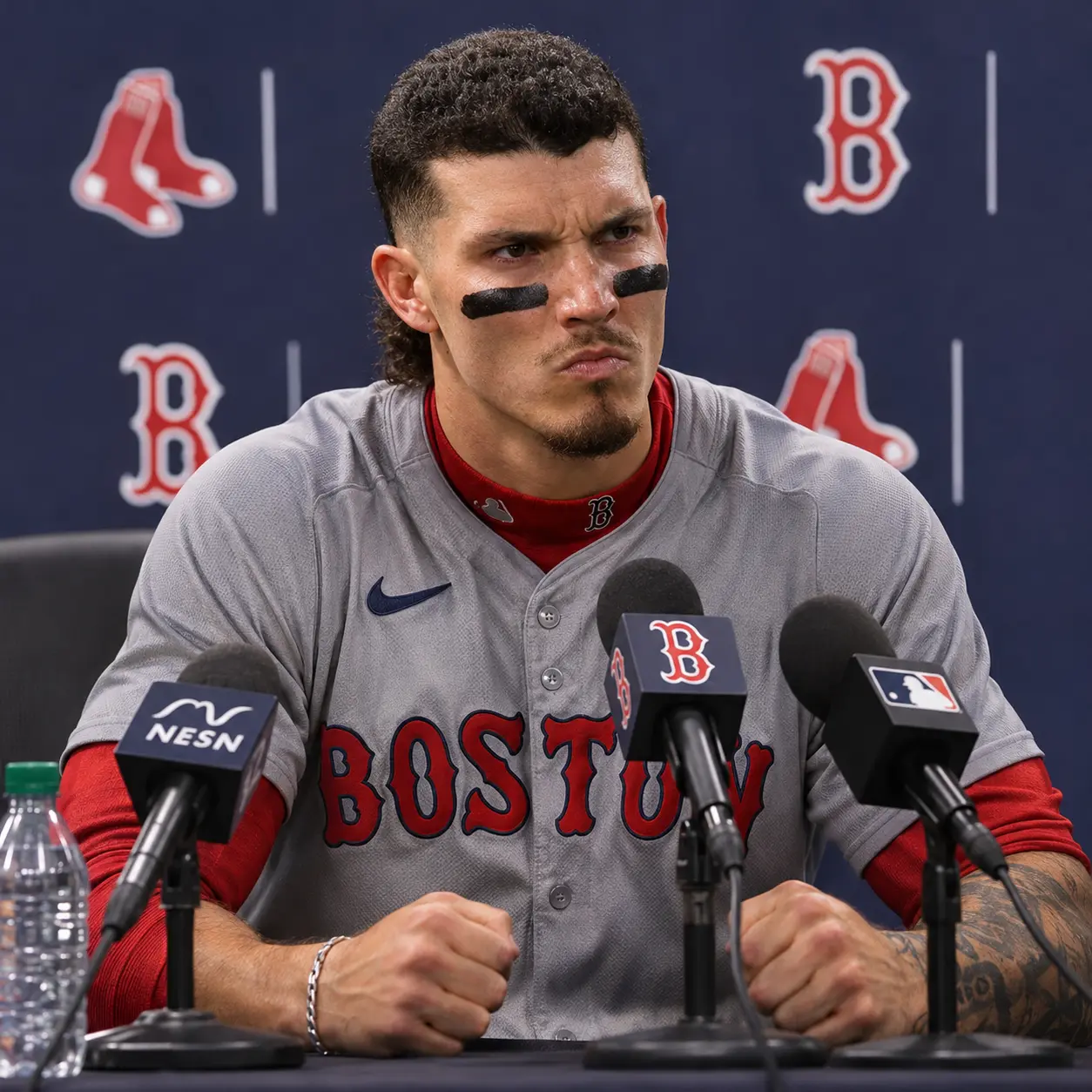
🚨 “IN BOSTON, YOU CAN BE HAILED LIKE A SAINT WHEN YOU’RE PLAYING AT YOUR BEST — BUT ONE MISTAKE CAN MAKE EVERYTHING COME CRASHING DOWN…” JARREN DURAN OPENS UP ABOUT THE PRESSURE, CRITICISM, AND EMOTIONAL STRUGGLES BEHIND HIS JOURNEY WITH THE BOSTON RED SOX
The pressure of playing in Boston is unlike almost anything else in professional baseball. Every hit is celebrated, every spectacular play becomes a headline, and every mistake can quickly turn into a subject of intense public debate. For Jarren Duran, that reality has become an increasingly complicated part of his journey with the Boston Red Sox.
The talented outfielder has experienced both sides of the spotlight. He has enjoyed the excitement of becoming an All-Star, received recognition for his extraordinary performances, and earned admiration from fans who believe he represents an important part of Boston's future. Yet he has also experienced criticism, disappointment, and moments when the expectations surrounding him appeared almost impossible to escape.
His journey illustrates the complicated relationship between professional athletes and the cities they represent.
Duran's rise to prominence reached an important milestone during the 2024 season. He emerged as one of baseball's most exciting players, earning an All-Star selection and establishing himself as a major contributor to the Red Sox lineup. His speed, aggressive style, and ability to create opportunities made him a player opposing teams had to take seriously.
For Boston supporters, he represented excitement and possibility.
But professional sports rarely allow players to remain at the top without facing new challenges. The expectations that follow an exceptional season can become a burden, particularly when performances begin to fluctuate.
Duran experienced that reality as his subsequent seasons brought greater scrutiny. Questions about his consistency, reactions on the field, and ability to handle pressure became increasingly prominent in conversations surrounding the organization.
The situation became particularly emotional because Duran had previously spoken publicly about his mental health struggles.
In Netflix's documentary series The Clubhouse: A Year with the Red Sox, released in 2025, he revealed the seriousness of the depression he experienced during the difficult 2022 season. His account included a suicide attempt, a deeply personal experience that helped audiences understand the challenges he had faced beyond the baseball field.
That revelation changed the way many supporters viewed the athlete.
Behind the uniform was a person who had experienced enormous emotional difficulties while trying to establish himself in one of professional baseball's most demanding environments.
For some fans, his honesty was courageous. Others recognized that professional athletes face pressures that are often difficult for outsiders to understand.
However, opening up about personal struggles also exposed Duran to another uncomfortable reality: not everyone responds to vulnerability with compassion.
In April 2026, during a game against the Minnesota Twins, Duran directed an obscene gesture toward a fan as he returned to the dugout. Afterward, he explained that the spectator had made a deeply personal comment telling him to kill himself.
Duran acknowledged that he should not have reacted with the gesture, but also described the comment as triggering because of his previous mental health experiences.

The incident generated considerable discussion throughout the baseball community.
It raised questions about the boundaries between passionate fan behavior and personal harassment. Athletes understand that criticism comes with professional competition, but comments targeting deeply personal experiences represent something entirely different.
For Duran, the incident demonstrated how difficult it can be to separate the demands of competition from the emotional consequences of public attention.
There was also another important detail in his explanation. He admitted that he had tried to keep the incident to himself rather than immediately bringing it to the attention of his teammates.
He did not want to distract the organization from its primary objective of winning games.
That decision revealed something about the pressure he felt to remain focused even when dealing with something personally upsetting.
The challenges did not disappear as the 2026 season progressed.
Duran experienced a difficult stretch statistically, and his position within the Red Sox organization became a subject of speculation. Trade rumors circulated, while questions emerged about whether Boston would continue relying on him as part of its long-term plans.
The uncertainty reached a significant point around the MLB trade deadline.
In August, Duran admitted that he had genuinely thought he might be released because of his disappointing performance. He expressed gratitude for the opportunity to remain with Boston and continue contributing during the remainder of the season.
His honesty offered another glimpse into the emotional reality of professional baseball.
For an athlete who had previously experienced the excitement of an All-Star campaign, confronting the possibility of losing his place on a major-league roster was undoubtedly a difficult professional moment.
It also demonstrated how quickly circumstances can change.
One season, a player can become one of the most celebrated members of an organization. Another season, the same player may find himself answering difficult questions about his future.
That contrast is particularly noticeable in Boston, where baseball has an enormous place in the city's sporting identity.
Red Sox supporters are passionate, knowledgeable, and deeply invested in their team's success. Fenway Park is more than a stadium; it is a place where expectations, history, and emotion come together.
For players, that environment can be incredibly motivating.
But it can also become exhausting when every performance feels like a public judgment of their value.
Duran's experiences have illustrated both realities.
His struggles have not erased the talent that made him an All-Star, and his difficult moments do not define his entire professional identity. Baseball careers are rarely straightforward, particularly for players who must navigate injuries, performance fluctuations, media attention, and the psychological demands of competing at the highest level.
What matters now is how he responds to those challenges.
The Red Sox organization has also publicly demonstrated support for Duran during difficult moments. Following the April incident involving the Minnesota fan, chief baseball officer Craig Breslow expressed the team's support and praised Duran for being open about his mental health challenges.
That support is important because professional athletes need environments where they can acknowledge difficulties without feeling that every personal struggle threatens their place on the team.
For Duran, rebuilding consistency and confidence remains an important part of his baseball journey.
He possesses the speed, athleticism, and competitive ability that made him one of Boston's most exciting players. The challenge is translating those qualities into sustained performances while managing the expectations that accompany his position.
Fans will continue evaluating his statistics, his decisions, and his contributions to the team. That is an unavoidable part of professional sports.
But there is another side to the story that deserves attention.
An athlete can be disappointed with his performance without deserving personal attacks. He can be held accountable for his actions while still receiving compassion when dealing with difficult experiences.
Those ideas are not contradictory.
Perhaps the most important lesson from Duran's journey is that the people behind professional sports deserve to be treated as human beings, regardless of their statistics or public reputation.
The phrase about Boston's supporters treating players like saints when they perform well, only to turn against them after mistakes, captures a broader discussion about the intensity of professional sports culture.
It is a reminder that admiration can sometimes become conditional, and that the expectations placed on athletes can change dramatically from one game to the next.
Jarren Duran has experienced the excitement of recognition and the frustration of criticism. He has shared deeply personal experiences, confronted difficult moments, and continued working to find his place in an organization where expectations remain extraordinarily high.
His story is not simply about baseball statistics or whether he can return to his best form.
It is also about resilience, accountability, public pressure, and the importance of recognizing the person behind the uniform.
As his career with the Red Sox continues, supporters will be watching closely to see what comes next.
And perhaps the biggest question is no longer whether Jarren Duran can handle the pressure of Boston.
It is whether Boston can recognize that even its most talented athletes are human beings who deserve understanding when things do not go according to plan.
Because in baseball, one great performance can make someone a hero. But true respect should never disappear after one bad game.