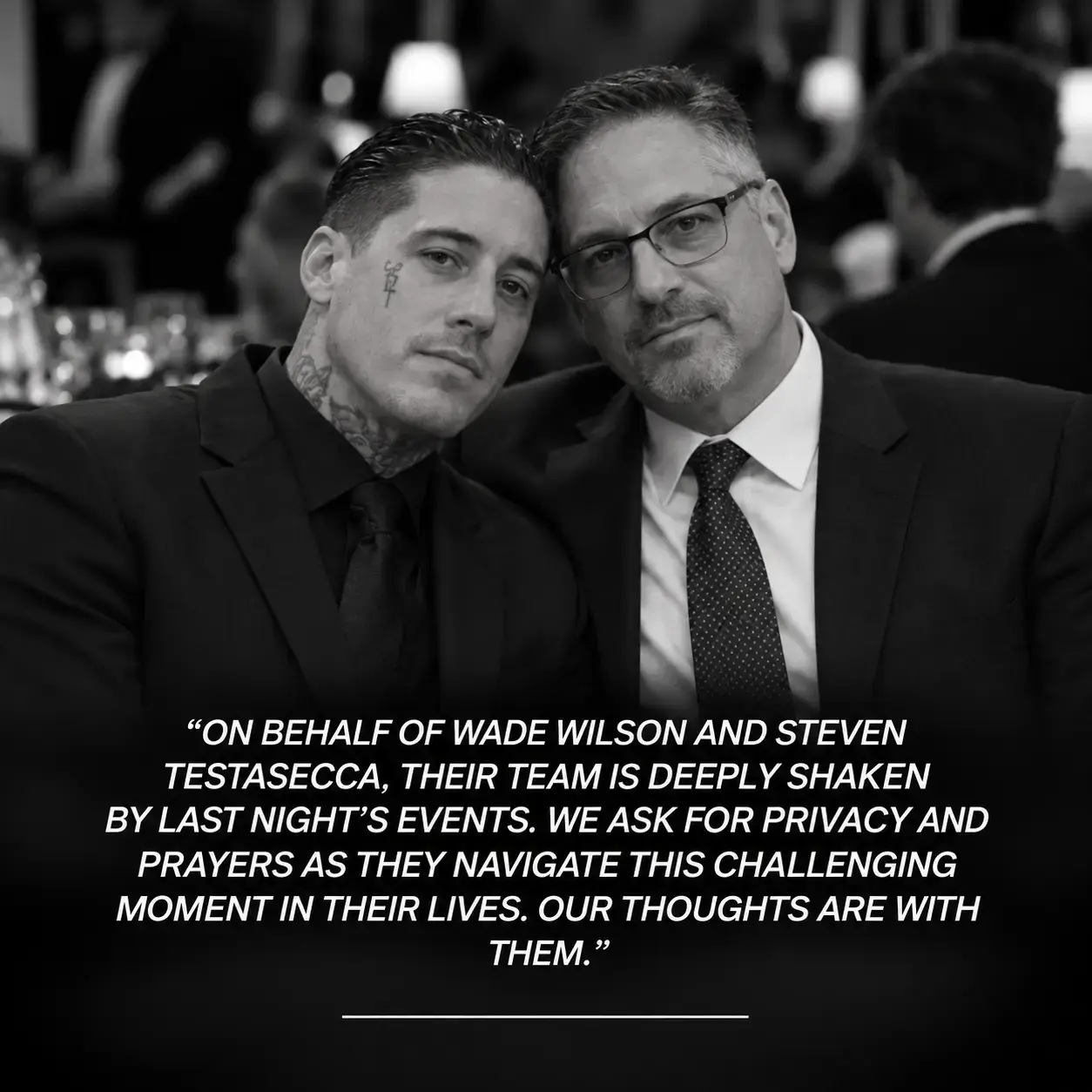
💔 HEARTBREAK ACROSS AMERICA: WADE WILSON'S BIOLOGICAL FATHER FACES THE PAINFUL TRUTH ABOUT HIS SON — AND THE DECISION THAT CHANGED EVERYTHING

FLORIDA — Few family stories present a moral dilemma as devastating as the one faced by Steven Testasecca, the biological father of convicted murderer Wade Wilson.
For years, their relationship had been marked by separation, sporadic contact, and attempts to reconnect. But on October 7, 2019, a series of telephone calls transformed that complicated family history into something far more disturbing.
Wilson, who would later be convicted of murdering Kristine Melton and Diane Ruiz, contacted his father and began describing acts of violence that Testasecca initially struggled to believe.
What followed became one of the most consequential decisions in the case.
Rather than help his son escape, Testasecca cooperated with law enforcement.
His actions helped authorities locate Wilson and bring him into custody.
Years later, the father's courtroom testimony offered a troubling account of the phone calls and the impossible position in which he found himself.
It is a story about family ties, personal responsibility, and the moment when protecting others must take precedence over protecting someone you love.
A Father and Son Separated From the Beginning
Wade Wilson was born in 1994 and placed for adoption while his biological parents were teenagers.
Testasecca later explained during the murder trial that he was approximately fourteen or fifteen years old when he learned he would become a father.
Wilson was raised by adoptive parents, while contact with his biological father did not become established until he was older.
According to Testasecca's testimony, Wilson reached out when he was eighteen.
Their relationship, however, did not develop into a consistently close father-son bond.
They communicated intermittently, and Testasecca recalled that Wilson sometimes contacted him seeking financial assistance.
The circumstances created a complicated relationship between two people connected by biology but separated through much of Wilson's upbringing.
For many families, reconnecting after years apart can offer opportunities to build trust and understanding.
In this case, however, the reunion eventually became intertwined with a criminal investigation that would attract national attention.
The Phone Calls That Changed Everything
On October 7, 2019, Wilson contacted his biological father.
According to testimony presented during the June 2024 trial, Wilson began describing actions that Testasecca found difficult to comprehend.
At first, the father believed his son might be inventing a story.
Testasecca explained that Wilson had a reputation for telling elaborate stories, which contributed to his initial disbelief.
But as the calls continued, the details became increasingly disturbing.
Wilson described the killings of two women in Florida.
Testasecca eventually realized that the situation might be real.
The father later testified that Wilson did not appear remorseful while recounting the violence.
That assessment became a significant part of the prosecution's presentation.
It also helps explain why Testasecca's decision to cooperate with investigators became so important.
The Victims Behind the Tragedy
The two women at the center of the case were Kristine Melton, 35, and Diane Ruiz, 43.
Melton was killed after meeting Wilson at a bar and returning to her home.
Ruiz encountered Wilson later that day.
Prosecutors presented evidence that Wilson attacked and killed both women in separate incidents.
The details revealed during the trial were deeply disturbing.
But beyond the forensic evidence and courtroom testimony were two people whose lives were abruptly taken.
Their families were left to confront an irreversible loss.
As public interest in Wilson's appearance, behavior, and family history grew, the victims' identities sometimes risked being overshadowed.
Yet the case exists because Melton and Ruiz were murdered.
Any discussion of Wilson's relationship with his father must keep that central fact in view.
A Father's Impossible Decision
As the telephone conversations continued, Testasecca faced a critical choice.
Wilson wanted assistance leaving the area.
His father could have attempted to help him.
Instead, Testasecca worked to determine his son's location while information was being relayed to law enforcement.
According to trial testimony, he told Wilson that he would arrange transportation.
But rather than helping him escape, Testasecca provided information that allowed authorities to find him.
Wilson was arrested the following day.
Testasecca later explained that his concern extended beyond the crimes already committed.
He feared that additional people could be harmed if his son remained free.
The decision placed him in an extraordinarily difficult position.
He was a father responding to his son's request for help.
But he was also a person who had learned information about two killings and recognized a responsibility to protect others.
His cooperation became a defining moment in the investigation.
The Courtroom Testimony That Captured National Attention
In June 2024, Testasecca took the witness stand during Wilson's murder trial.
His testimony provided jurors with an account of the calls he received on the night of the killings.
He described his initial disbelief and the point at which he began to accept that Wilson was telling the truth.
Prosecutors also questioned him about his son's demeanor.
Testasecca testified that Wilson appeared excited rather than remorseful when discussing the crimes.
The testimony was significant because it gave the jury an account of Wilson's own statements shortly after the murders.
It also revealed how a family member had become a crucial witness for the prosecution.
There was no need for an invented emotional speech to make the situation compelling.
The documented facts were already extraordinary.
A father had listened to his son describe the deaths of two women.
He had then helped authorities locate that son.
And years later, he had to recount the experience under oath.

Love Does Not Erase Accountability
The relationship between a parent and child can be one of the most enduring connections in human life.
But family loyalty can become painfully complicated when a loved one commits a serious crime.
Testasecca's actions illustrate a difficult distinction between caring about a person and protecting that person from the consequences of their conduct.
Helping Wilson escape might have preserved an immediate sense of loyalty.
It could also have placed other people at risk.
Cooperating with police meant acknowledging the seriousness of what he had heard.
It also meant accepting that his son's future would be determined through the criminal justice system.
The choice did not require Testasecca to stop being Wilson's biological father.
It required him to recognize that family ties could not override the safety of others.
That is one of the central moral questions raised by this case.
The Verdict That Changed Their Lives
In June 2024, a Florida jury convicted Wilson of two counts of first-degree murder.
The verdict followed testimony from investigators, forensic experts, and other witnesses, including his biological father.
During the penalty phase, jurors recommended death sentences.
On August 27, 2024, Circuit Judge Nicholas Thompson sentenced Wilson to death for both murders.
The outcome marked a major turning point in the case.
For Wilson, it meant entering Florida's death row system.
For the victims' families, it represented a significant stage in the pursuit of accountability.
For Testasecca, it brought another consequence of the decision he had made nearly five years earlier.
The father who helped authorities find his son had also become a witness in the proceedings that ended with two death sentences.
The Emotional Weight of Family Responsibility
It is impossible to know every private thought Testasecca has experienced since the arrest and trial.
His public testimony provides insight into his decision, but it does not establish every emotion he may have felt afterward.
That distinction matters.
Dramatic headlines may describe him as devastated, heartbroken, or consumed by regret.
Without a verified statement, those descriptions should not be presented as direct accounts of his current feelings.
Nevertheless, the circumstances raise understandable questions about the emotional burden of cooperating against a family member.
How does a parent reconcile biological connection with the reality of a violent crime?
What does loyalty mean when another person's safety is at stake?
And how does a family move forward after its private history becomes part of a nationally discussed murder case?
These questions have no simple answers.
They are among the reasons the story continues to resonate.
A Case That Continues to Draw Attention
Wilson's case has remained prominent in true-crime coverage, including documentaries and discussions about the death penalty.
His appearance and public notoriety have attracted considerable online attention.
But fascination with a convicted murderer can distort the focus of a criminal case.
The important questions concern the evidence, the victims, the legal process, and the decisions made by those involved.
Testasecca's testimony is particularly significant because it demonstrates how a family member's cooperation can contribute to an investigation.
He did not simply provide background information about Wilson's childhood.
He helped authorities locate someone who had admitted to committing two killings.
That contribution became part of the documented history of the case.
The Families Who Carry the Greatest Loss
While the father-son relationship has attracted attention, the deepest tragedy belongs to the families of Kristine Melton and Diane Ruiz.
They lost loved ones whose lives cannot be restored by a verdict or sentence.
No discussion of Wilson's family circumstances should diminish that reality.
The victims were more than names in court documents.
They were women with relationships, responsibilities, and futures that were taken away.
Their deaths remain the central human cost of the crimes.
Recognizing the difficult position of Wilson's biological father does not require sympathy for Wilson's actions.
Nor does acknowledging family complexity lessen the importance of justice for the victims.
Both realities can be discussed without confusing their moral significance.
The Lesson Behind a Father's Decision
The story of Steven Testasecca and Wade Wilson is not a conventional account of reconciliation.
It is the story of a relationship shaped by separation, renewed contact, and a devastating revelation.
When Wilson contacted his father after the murders, Testasecca faced a choice that would have lasting consequences.
He chose to cooperate with authorities.
His testimony later helped explain why he believed that decision was necessary.
The documented events offer a powerful lesson about the limits of family loyalty.
Love and responsibility do not always point in the same direction.
Sometimes protecting the wider community requires making a decision that brings painful consequences for someone within one's own family.
A Final Reflection
Years after the killings of Kristine Melton and Diane Ruiz, the case continues to prompt discussions about justice, accountability, and family responsibility.
Steven Testasecca's role remains one of its most striking elements.
He was not a distant observer.
He was Wilson's biological father, the person Wilson contacted while seeking help after the murders.
And he became the person whose cooperation helped bring Wilson into custody.
The most powerful part of this story is not an unverified new emotional confession. It is the documented decision a father made when confronted with the terrible truth about his son.
That decision did not undo the violence.
It could not return Kristine Melton and Diane Ruiz to their families.
But it helped bring the person responsible before the justice system.
And it remains a reminder that sometimes the hardest expression of responsibility is refusing to protect someone from the consequences of their actions — even when that person is your own child.