🚨 GAVIN NEWSOM’S BLUNT TRUMP REMARK ON JIMMY KIMMEL LIVE SPARKS A BIGGER QUESTION: HOW SHOULD ELECTED LEADERS TALK ABOUT THEIR POLITICAL OPPONENTS?
California Governor Gavin Newsom’s latest appearance on Jimmy Kimmel Live! was never likely to be a quiet political interview.
But one particularly blunt line quickly became the kind of sound bite destined to travel far beyond the late-night television audience.
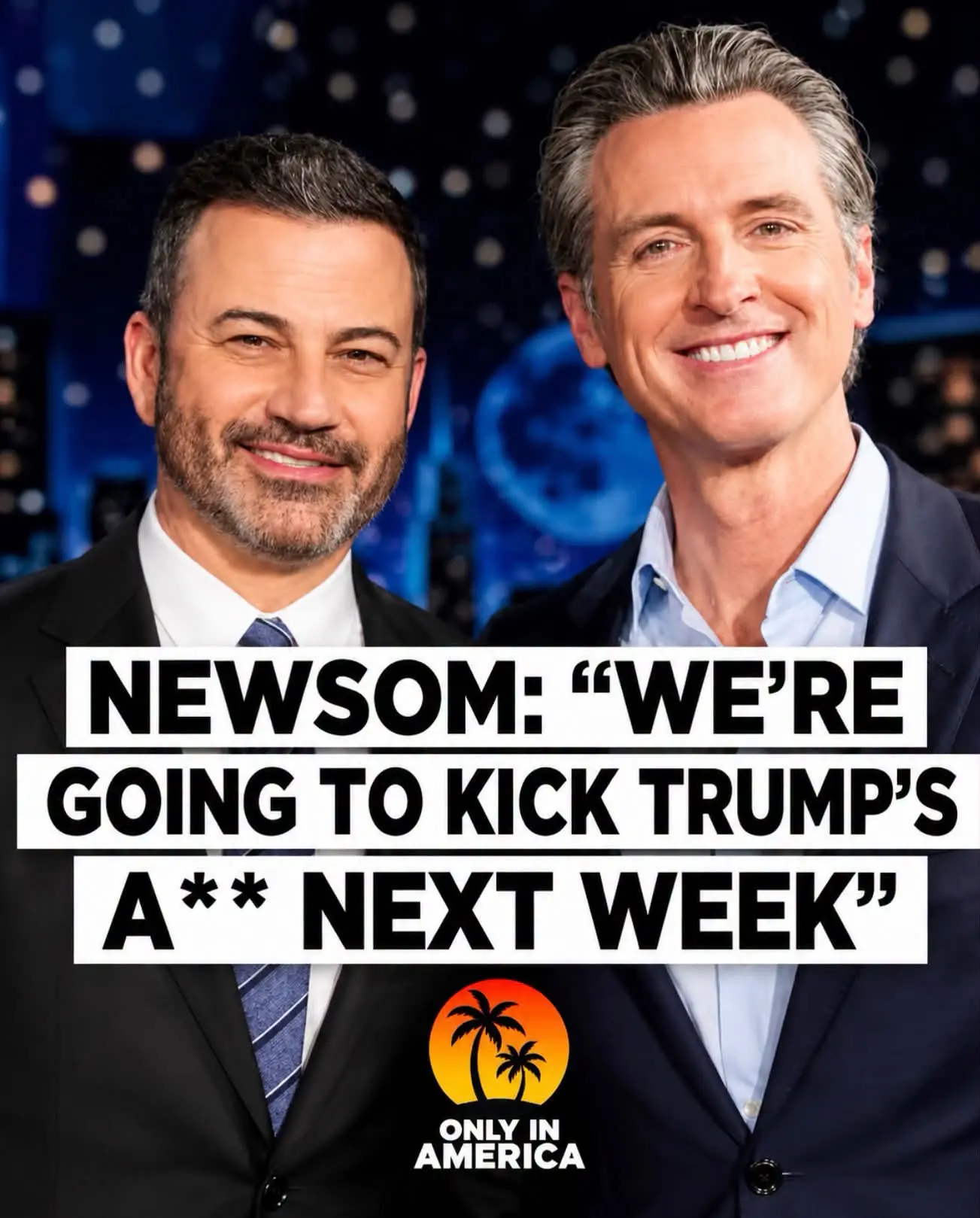
During his October 28 appearance, Newsom was discussing President Donald Trump, the approaching midterm elections, and what he believed could happen when Americans went to the polls.
The conversation eventually turned humorous when Jimmy Kimmel brought up Trump’s tendency to comment on other people’s physical appearance.
Newsom responded with a joke about Trump having a fixation on people’s backsides.
Then came the line that immediately attracted attention:
“The only ass I care about is the one we’re going to kick on Tuesday.”
The remark was clearly political rather than a literal threat. Newsom was talking about defeating Trump’s political agenda and Republican candidates at the ballot box in the November 3 midterm elections.
But the language raises an interesting question that goes well beyond Newsom or Trump:
How should a governor speak about the President of the United States?
There is no single answer Americans are required to accept.
For Newsom’s supporters, the line may sound like ordinary political trash talk — particularly in an era when politicians routinely communicate through social media, podcasts, rallies and entertainment programs rather than traditional formal speeches.
From that perspective, Newsom was appearing on a comedy show, responding to a joke and using colorful language to express confidence about an election.
His critics can reasonably see the situation differently.
To them, a sitting governor using that kind of language about a sitting president may appear unnecessarily crude and inconsistent with the level of decorum they expect from elected officials.
Both reactions illustrate a broader transformation in American political communication.
Political rhetoric has become increasingly informal, personal and designed for rapid circulation online.
A carefully constructed paragraph about constitutional checks and balances might receive modest attention.
A seven-second clip containing the phrase “kick his ass” can immediately explode across social media.
Newsom clearly understands that environment.
His political communication in recent years has frequently mixed conventional policy arguments with trolling, humor and deliberately provocative language.
Trump, of course, has also spent years employing insults and mocking nicknames against political opponents, journalists and other public figures.
That context does not automatically make Newsom’s language appropriate or inappropriate.
Instead, it helps explain why politicians increasingly believe aggressive rhetoric can be politically useful.
Newsom’s appearance contained considerably more substance than the viral line alone suggests.
He predicted major Democratic gains in the midterms and described what he expected to be a “blue tsunami.” He argued that control of the House could restore Congress as a stronger counterweight to the executive branch, while acknowledging that the Senate outcome was less certain.
Newsom also raised concerns about potential disputes surrounding election administration and said California was preparing poll workers, election lawyers and other resources.
Those are consequential political claims deserving scrutiny on their own.
But they are much harder to package into a viral clip.
“The only ass I care about is the one we’re going to kick on Tuesday” is different.
Everyone immediately understands it.
And that illustrates one of the central problems — or advantages, depending on your perspective — of modern political communication.
Provocation gets attention.
The more interesting issue is whether that attention helps citizens understand anything meaningful about government.
There is also an important distinction between criticizing the presidency as an institution and criticizing the individual occupying the office.
American democracy has never required governors, lawmakers or ordinary citizens to treat presidents as immune from harsh criticism.
Political opposition is built into the constitutional system.
Governors regularly challenge presidents in court, criticize federal policies and campaign against the president’s party.
Respect for the office does not require agreement with the officeholder.
At the same time, Americans have long debated whether elected officials should voluntarily maintain a higher standard of rhetoric precisely because they hold public office.
That is where reactions to Newsom’s comment are likely to diverge.
One voter may hear an energetic campaign joke.
Another may hear language beneath the dignity of a governor.
Another may care far less about the vocabulary than about the policies being debated.
And someone else may conclude that politicians across the ideological spectrum have become too focused on generating viral confrontation.
Those are ultimately judgments voters make for themselves.
It is also worth remembering what Newsom was actually describing.
The “kick” in his statement referred to an election.
In a democracy, political opponents are defeated through ballots.
Voters choose representatives.
Parties gain or lose seats.
Governments face electoral consequences.
Newsom was expressing confidence that voters would reject Trump-aligned candidates and constrain the president politically.
Whether that confidence proves justified is a separate question that only election results can answer.
The controversy surrounding the language therefore reveals something bigger than one late-night television appearance.
American politics increasingly operates partly as entertainment.
Politicians need clips.
Television programs need memorable moments.
Social platforms reward confrontation.
Supporters reward politicians who appear willing to fight.
And opponents amplify outrageous statements because those statements reinforce their own criticisms.
The result can become a feedback loop in which the most provocative sentence receives vastly more attention than the policy discussion surrounding it.
Newsom’s comment fits almost perfectly into that environment.
Was it colorful?
Absolutely.
Was it aimed at political defeat rather than physical violence?
The context indicates that it was.
Was it appropriate language for a governor discussing the president?
That is an evaluative question on which Americans can reasonably reach different conclusions based on what they expect from elected officials.
Some prioritize institutional decorum.
Others value combative opposition.
Others judge politicians primarily on policy and consider rhetorical disputes a distraction.
Perhaps the most useful question, then, is not simply whether Newsom crossed a line.
It is what standard Americans want applied consistently — whether the politician speaking is Gavin Newsom, Donald Trump, or anyone else.
Because political standards mean considerably more when they apply to people we support as well as people we oppose.
And when the cheering and outrage surrounding the latest viral clip eventually disappear, voters still have to decide what matters most:
The language politicians use, the policies they pursue, the institutions they respect — and the results they deliver.