🚨🇺🇸 BREAKING NEWS FROM WASHINGTON, D.C.: SENATOR JOHN KENNEDY’S FIERY RESPONSE TO A TV PRESENTER SPARKS AN EXPLOSIVE DEBATE OVER FREE SPEECH, THE 2026 MIDTERM ELECTIONS, AND RESPECT IN AMERICAN POLITICS
The following is a dramatized political news scenario. The alleged interview, confrontation, quotations, and walkout have not been independently verified as real events.
WASHINGTON, D.C. — A tense exchange involving Louisiana Senator John N. Kennedy and a television news presenter forms the center of a dramatic political scenario that raises difficult questions about freedom of speech, the responsibilities of elected officials, and the increasingly confrontational atmosphere surrounding American politics.
What begins as a seemingly ordinary discussion about the 2026 midterm elections quickly develops into a heated disagreement over whether lawmakers should publicly express strong political opinions while representing the American people.
At the heart of the confrontation is a question that has become increasingly relevant in modern political discourse: Where should the line be drawn between legitimate political expression and the responsibility to maintain respectful public debate?
For Senator Kennedy, whose public reputation has been shaped partly by his direct speaking style and memorable remarks during congressional hearings, the issue presents an opportunity to defend the rights of elected representatives to participate openly in political discussions.
But in this imagined televised interview, the disagreement becomes personal when the presenter challenges whether lawmakers should exercise greater restraint when discussing controversial election issues.
The exchange begins calmly.
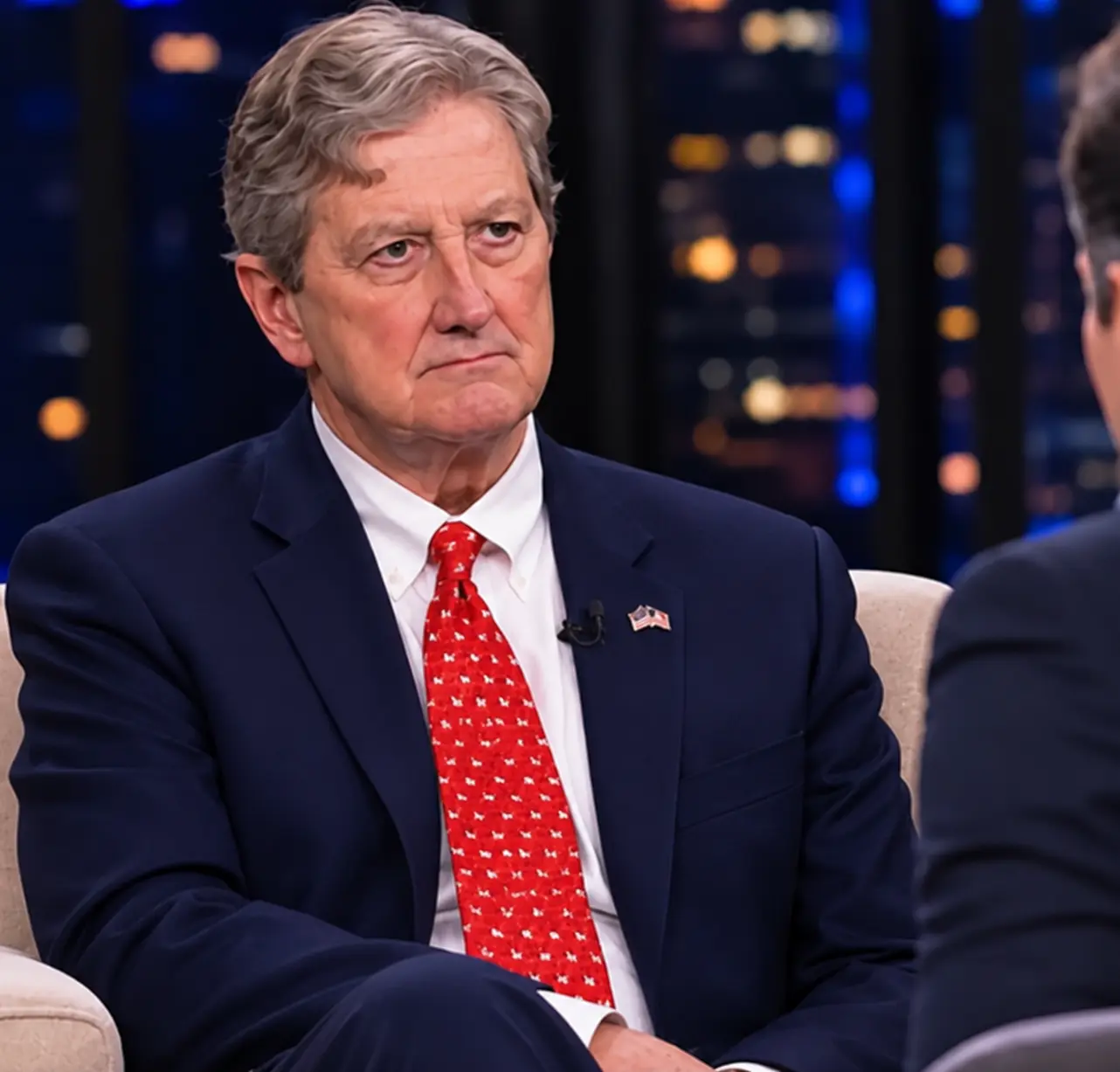
Kennedy sits across from the presenter in a Washington television studio, with the United States Capitol visible on a large screen behind them.
The discussion initially focuses on the political environment surrounding the 2026 midterm elections, including voter concerns, congressional priorities, and the growing importance of public communication.
The presenter asks Kennedy whether politicians have a responsibility to avoid statements that could deepen divisions among voters.
Kennedy acknowledges the importance of respectful disagreement but emphasizes that elected officials also have a responsibility to communicate their positions clearly.
The presenter then presses the issue further.
Should lawmakers refrain from expressing strong personal opinions when those opinions might offend portions of the electorate?
The question changes the atmosphere.
Kennedy leans forward slightly.
His expression becomes more serious.
And the conversation shifts from election strategy to the constitutional principles governing political expression.
In the dramatized exchange, Kennedy responds:
"The American people didn't elect us to remain silent whenever someone disagrees with what we have to say."
The statement captures the central argument behind his position.
Elected representatives are expected to participate in public debate, defend policy preferences, and explain their political judgments to voters.
The ability to express disagreement is an essential feature of democratic government.
But that freedom also exists alongside expectations of honesty, accountability, and respect for democratic institutions.
The presenter challenges Kennedy on this distinction.
While lawmakers have the right to express political opinions, the presenter argues, their public statements carry unusual influence.
An ordinary citizen expressing frustration online may reach a relatively small audience.
A United States senator, however, can influence national conversations, shape political narratives, and affect public confidence in democratic institutions.
That influence creates responsibilities beyond the simple question of whether a statement is legally protected.
Kennedy listens before offering a different perspective.
In the imagined conversation, he argues that political accountability should come primarily through public debate and elections rather than through pressure to avoid controversial opinions.
If voters disagree with a senator's statements, they can challenge those statements, organize opposition, and ultimately make their preferences known at the ballot box.
That process, he suggests, is central to representative democracy.
The presenter remains unconvinced.
The conversation becomes increasingly tense as both participants return to the same underlying disagreement.
Does political leadership require greater restraint?
Or does democracy become weaker when elected officials feel pressured to soften their views to avoid criticism?
The distinction matters because freedom of speech is not the same as freedom from consequences.
The First Amendment places important restrictions on government interference with protected expression.
It does not guarantee that public statements will be free from criticism, questioning, or disagreement.
Nor does it prevent journalists from challenging elected officials about the accuracy, implications, or consequences of their remarks.
In fact, the ability of journalists to question powerful political figures is itself an important component of a free society.
The imagined interview illustrates the tension between these two democratic principles.
Kennedy emphasizes the right of lawmakers to speak openly.
The presenter emphasizes the responsibility of journalists to challenge those statements.
Both positions can coexist within a functioning democracy.
The disagreement arises over how those responsibilities should be exercised.
As the exchange continues, the presenter asks whether inflammatory political rhetoric can undermine public trust.
The question is especially significant during election seasons, when political messaging often becomes more aggressive and emotionally charged.
Candidates compete for attention.
Campaign advertisements emphasize sharp contrasts.
Social media rewards dramatic statements.
And voters frequently encounter political information through short clips that may lack the context of longer conversations.
These conditions can make nuanced discussion more difficult.
A statement intended to explain a policy disagreement may be interpreted as a personal attack.
A challenging interview question may be perceived as evidence of political bias.
And an exchange that could have remained a substantive disagreement may become a confrontation.
In the dramatized scenario, Kennedy expresses frustration with what he considers an unfair framing of the discussion.
He argues that criticism of political speech should not automatically become an argument for political silence.
The presenter responds that asking lawmakers to consider the consequences of their words is not equivalent to censorship.
The distinction becomes the central source of conflict.
Kennedy insists that public officials must be willing to defend their positions, even when those positions are unpopular.
The presenter counters that public officials should also be prepared to answer difficult questions about those positions.
Neither participant appears willing to abandon the argument.
The atmosphere inside the studio grows increasingly uncomfortable.
Kennedy's responses become shorter.
The presenter continues pressing for clarification.
And the discussion moves away from specific election issues toward the broader question of who gets to define acceptable political discourse.
In the imagined turning point, the presenter asks whether Kennedy believes elected officials should face any professional or political consequences for statements that contribute to public hostility.
Kennedy pauses.
He looks directly toward the presenter.
Then he responds:
"Disagreement is not disrespect. And asking questions is not the same thing as telling someone they shouldn't be allowed to answer."
The remark highlights an important distinction.
A democracy depends on the ability to disagree without automatically treating opposing views as illegitimate.
But respectful disagreement also requires participants to recognize that others possess the same right to challenge their arguments.
That principle applies equally to politicians, journalists, and ordinary citizens.
The presenter attempts to clarify the question, explaining that the concern is not whether lawmakers can speak but whether they should consider the broader consequences of their rhetoric.
Kennedy responds that the American public is capable of evaluating political arguments without needing every disagreement to be softened or avoided.
The conversation reaches an impasse.
In the dramatized scene, Kennedy slowly removes his microphone earpiece and places it on the desk.
The presenter appears surprised.
Kennedy stands, adjusts his jacket, and prepares to leave.
Before walking away, he offers a final statement:
"If we're going to talk about freedom of expression, we ought to begin by respecting everyone's right to participate in the conversation."
He then turns and walks off the set.
The presenter remains seated as the broadcast moves to a commercial break.
The imagined walkout becomes the most visually dramatic moment of the encounter.
But its political significance depends on how the confrontation is interpreted.
Supporters of Kennedy's position might view his departure as a protest against what they perceive as unfair questioning or an attempt to restrict legitimate political expression.
From that perspective, the walkout represents frustration with a media environment in which politicians sometimes believe their statements are judged according to political preference rather than consistent standards.
Critics, however, might interpret the same action differently.
They could argue that elected officials have a responsibility to answer difficult questions, particularly when those questions concern public accountability and democratic norms.
Walking away from an uncomfortable interview, under that interpretation, does not resolve the underlying disagreement.
It simply ends the opportunity for further clarification.
A third perspective focuses less on the conduct of either participant and more on the broader environment that makes confrontations increasingly attractive to political audiences.
Televised political interviews have become important sources of short-form digital content.
A tense exchange can be edited into a brief clip.
A sharp remark can become a headline.
And a dramatic departure can attract more attention than an extended policy discussion.
The result is a media environment in which conflict often receives greater visibility than careful explanation.
That does not mean confrontational interviews are inherently unproductive.
Journalists sometimes need to ask persistent questions to obtain meaningful answers.
Politicians may need to challenge assumptions they believe are inaccurate.
But when a discussion becomes primarily about the personalities involved, the original policy issues can disappear.
In this imagined confrontation, the 2026 midterm elections provide the starting point.
Yet the conversation gradually becomes a dispute about speech, respect, and the legitimacy of criticism.
The specific concerns facing voters receive less attention.
Economic conditions, public spending, immigration, healthcare, national security, and other major policy questions remain important subjects for congressional debate.
Voters need clear information about those issues to evaluate candidates and elected officials.
When political conversations become dominated by personal confrontation, that information can become harder to obtain.
The scenario also raises questions about the relationship between journalism and political power.
A free press has an important responsibility to scrutinize public officials.
That scrutiny may involve uncomfortable questions, repeated requests for clarification, and challenges to unsupported claims.
At the same time, responsible journalism requires accuracy, fairness, and a willingness to distinguish evidence from interpretation.
An interviewer should not assume that disagreement automatically demonstrates wrongdoing.
Likewise, an elected official should not assume that persistent questioning automatically constitutes hostility.
Both sides contribute to public understanding when they engage seriously with the substance of an issue.
The challenge is maintaining those standards in a political culture increasingly shaped by immediate reactions.
Social media can amplify anger within seconds.
A single phrase can circulate without context.
And audiences may form conclusions before hearing the complete exchange.
For that reason, claims about dramatic political confrontations deserve careful verification.
An authentic recording, a complete transcript, and confirmation of when and where an interview occurred are important before treating a viral account as established fact.
Without that evidence, a compelling narrative should not be confused with a verified news report.
The dramatized Kennedy confrontation nevertheless illustrates a genuine democratic dilemma.
Americans expect their elected representatives to speak candidly.
They also expect those representatives to accept scrutiny.
They value freedom of expression.
But they frequently disagree about what respectful expression should look like.
These tensions are not unique to one senator, political party, or election cycle.
They are recurring features of a system built around disagreement, competing interests, and public accountability.
The central challenge is ensuring that disagreement remains productive rather than destructive.
A lawmaker can defend a controversial position without dismissing every critic.
A journalist can challenge a politician without treating disagreement as evidence of bad faith.
And voters can reject an argument without denying another person's right to make it.
Those principles are especially important during election seasons, when emotions are heightened and political incentives often reward confrontation.
In the imagined aftermath of Kennedy's departure, the unanswered questions remain.
Was the presenter asking for greater responsibility or implying that certain political opinions should not be expressed?
Was Kennedy defending an important democratic principle or avoiding a difficult question?
Could the disagreement have continued without either participant feeling compelled to end the conversation?
The scenario offers no simple answer.
Instead, it reveals how easily a debate about political expression can become a test of personal patience and mutual respect.
For the American public, the broader lesson is that freedom of speech and accountability should not be treated as opposing values.
They reinforce one another when practiced responsibly.
Freedom allows political leaders to explain their views.
Accountability allows citizens and journalists to examine those views.
Respect makes continued dialogue possible even when agreement remains unlikely.
And elections provide voters with an opportunity to evaluate the arguments, conduct, and priorities of those seeking public office.
Ultimately, the most important question raised by this dramatized Washington confrontation is not whether a senator should have walked away from an interview.
It is whether American political culture can preserve meaningful disagreement without allowing every difficult conversation to become a personal battle.
Because democracy does not require everyone to think alike.
It requires a willingness to defend ideas, examine evidence, challenge authority, and recognize the rights of others to participate.
And when political disagreements become heated, the true test of democratic leadership may not be who delivers the sharpest response — but who remains willing to engage with the questions that matter most to the American people.