MITCH McCONNELL’S WARNING TO TRUMP: A REPUBLICAN POWER STRUGGLE OVER PUTIN, UKRAINE, AND THE PRESIDENT’S AGENDA
The veteran Republican senator’s criticism of Donald Trump’s Russia policy has raised an important question in Washington: Could disagreements over Ukraine complicate the president’s efforts to advance his legislative priorities?

A Warning From Within the Republican Party
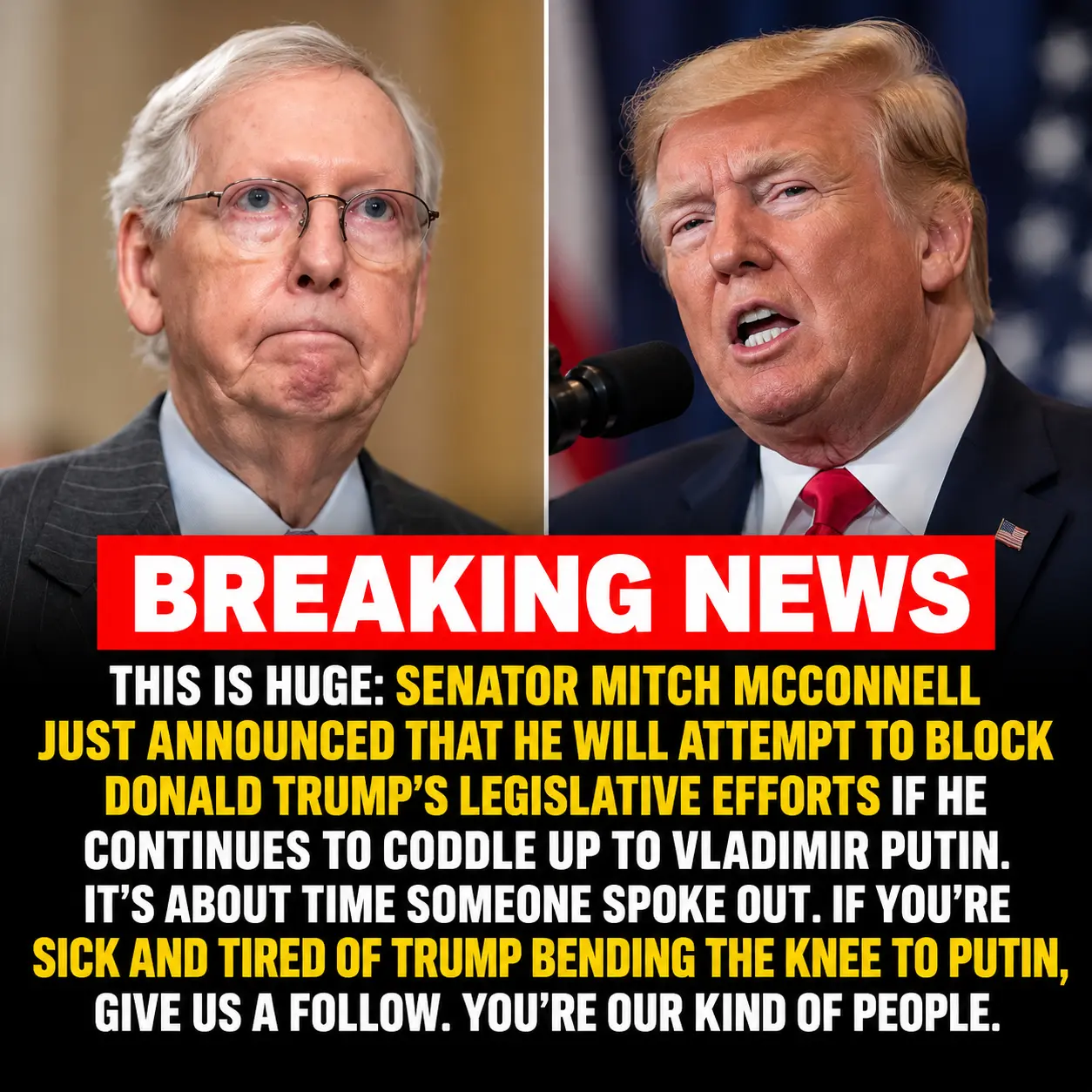
A political disagreement between two of the Republican Party’s most influential figures has brought renewed attention to the relationship between American foreign policy and domestic political power. Senator Mitch McConnell, the longtime Republican leader from Kentucky, has repeatedly argued that the United States must resist Russian aggression and maintain strong support for Ukraine. His position has placed him at odds with aspects of President Donald Trump’s approach to negotiations with Moscow and the future of the war. The disagreement carries particular significance because McConnell is not a Democratic opponent seeking to challenge Trump from outside the Republican coalition. He is a veteran conservative who spent decades shaping Republican legislative priorities, confirming conservative judges, and helping his party exercise power in Washington. His criticism therefore raises questions about the limits of Republican unity when foreign policy principles clash with presidential strategy. A widely circulated social media graphic goes further, claiming that McConnell announced he would attempt to block Trump's legislative efforts if the president continued accommodating Vladimir Putin. That specific claim requires careful scrutiny: criticism of a president's foreign policy does not automatically establish a formal commitment to obstruct legislation. Nevertheless, McConnell's publicly expressed concerns about Russia, Ukraine, and American leadership reveal a genuine policy disagreement with potentially significant implications for congressional negotiations.
The dispute comes at a time when Russia's invasion of Ukraine continues to shape international security debates, NATO relations, military spending priorities, and the broader question of American credibility abroad. Trump has emphasized negotiations and efforts to end the war, while critics argue that any settlement must avoid rewarding Russia's use of military force. McConnell has historically favored a more traditional Republican national-security approach, stressing deterrence, military strength, and the importance of alliances. These competing perspectives reflect a larger division within the party over America's international responsibilities. Some Republicans favor continued military assistance to Ukraine as an investment in preventing further Russian aggression. Others question the financial cost of overseas commitments and argue that Washington should prioritize domestic concerns. The political consequences of that disagreement depend not only on the statements made by prominent senators but also on the actual legislation brought before Congress, the positions of other lawmakers, and the willingness of party leaders to negotiate.
The October 2026 Opinion Piece That Intensified the Dispute
The latest flashpoint came on October 25, 2026, when McConnell published an opinion article in The Wall Street Journal titled “Coddling Putin Won’t Bring Peace to Ukraine.” The piece sharply criticized the administration's handling of Russia and argued that accommodating Putin would not produce the lasting settlement Trump seeks. McConnell objected to the president's recent approach to Russian energy and sanctions, questioning the wisdom of rewarding Moscow while Russian attacks on Ukraine continued. His criticism was not merely rhetorical. He explicitly connected the administration's Russia policy to the prospects for passing legislation during the post-election, lame-duck congressional session. McConnell argued that Trump's agenda would require cooperation from Republicans who maintain a clear distinction between American allies and adversaries. He suggested that ending the administration's deferential approach to Putin could become a condition for securing support on end-of-year legislation. This was a significant warning from a senator with extensive experience negotiating congressional spending and defense measures. However, it was not the same as announcing an unconditional plan to vote against every Trump proposal. The distinction matters: McConnell was signaling that foreign-policy disagreements could influence legislative cooperation, rather than presenting a detailed list of bills he intended to defeat.
ny1.com+2
McConnell's argument was especially pointed because it challenged a central assumption behind Trump's diplomatic approach: that direct engagement, economic flexibility, and negotiations with Moscow could create the conditions for ending the war. Trump and his administration have defended their efforts as attempts to halt the fighting and reduce further loss of life. In response to McConnell's opinion piece, a White House official emphasized the president's commitment to finding a peaceful settlement and expressed optimism that an agreement could eventually be reached. McConnell, however, argued that Russia's conduct made concessions dangerous unless accompanied by meaningful pressure. The disagreement was therefore not over whether the war should end. Both sides publicly described peace as a desirable outcome. The conflict concerned the means of achieving it, the credibility of Russian commitments, and the extent to which Washington should use economic and military leverage before accepting a settlement. Those differences can have direct consequences for Congress because foreign assistance, defense appropriations, sanctions, and executive authority often intersect with legislative negotiations.
Spectrum News 1+1
Why McConnell's Position Carries Political Weight

McConnell's warning deserves attention because of his unusual position within Republican politics. For years, he was central to the party's congressional strategy, serving as Senate Republican leader and helping shape major legislative battles. His influence extended across judicial nominations, tax policy, federal spending, and the procedural rules that govern the Senate. Although he no longer holds the party's top leadership position, his experience and longstanding relationships give his statements significance. He also chairs the Senate Appropriations Subcommittee on Defense, a role that connects his foreign-policy priorities directly to decisions about military funding. That connection makes the disagreement over Ukraine more than an abstract argument about international relations. Defense appropriations involve actual budget decisions, congressional oversight, and negotiations among lawmakers who may have different views about America's commitments overseas. McConnell's warning indicates that support for particular spending priorities cannot necessarily be assumed simply because the White House and Senate share a party affiliation. The Republican coalition includes lawmakers with different approaches to military assistance, fiscal policy, and executive power, and those differences can become especially important when legislative margins are narrow.
McConnell has also demonstrated that his criticism of Trump's Russia policy is not a sudden development. In February 2026, marking four years since Russia's full-scale invasion of Ukraine, he argued that lasting peace would require acknowledging Russia's responsibility for the war and demonstrating military strength. He emphasized the importance of continued assistance to Ukraine and the credibility of American commitments. In April, he published another opinion piece questioning why the Pentagon had not obligated funds that Congress had authorized for Ukrainian security assistance. These statements establish a consistent policy position: McConnell believes American support for Ukraine serves broader national-security interests and that reducing pressure on Moscow could undermine negotiations. His October intervention therefore fits into a longer pattern rather than representing an isolated personal disagreement with Trump.
PublicNow+2
The Russia-Ukraine War Behind the Political Clash

The dispute between McConnell and Trump cannot be understood without considering the war itself. Russia launched its full-scale invasion of Ukraine in February 2022, dramatically escalating a conflict that began in 2014. Russian forces initially attempted to advance toward Kyiv, but Ukrainian resistance prevented the rapid collapse of the government. The war subsequently developed into a prolonged conflict involving artillery, drones, missiles, fortified defensive positions, and repeated attacks on infrastructure. Ukrainian civilians have endured displacement, destruction, and the continuing threat of violence. Russia has also suffered extensive military losses, while the conflict has imposed significant economic and strategic costs on both countries. International efforts to end the fighting have faced persistent obstacles, particularly over territory, security guarantees, sanctions, and Ukraine's future relationship with Western institutions. The United States has played an important role through military assistance, financial support, diplomatic coordination, and sanctions policy. Because Washington possesses substantial economic and military influence, changes in American policy can affect both Ukraine's ability to defend itself and Russia's assessment of the costs of continuing the war.
McConnell's position rests on the argument that negotiations are more likely to produce a durable settlement when Ukraine has sufficient defensive capabilities and Russia faces meaningful consequences for continued aggression. This approach emphasizes deterrence and bargaining leverage. Critics of extensive American involvement raise different concerns, including the financial burden of military assistance, the danger of prolonged conflict, and the possibility that continued weapons transfers could delay a negotiated agreement. Those concerns form part of a legitimate policy debate about the proper balance between diplomacy, deterrence, and domestic priorities. The central disagreement is how best to reduce violence while avoiding an outcome that encourages further military aggression. McConnell has repeatedly argued that withholding assistance can embolden Putin rather than make compromise more likely. His statements reflect a longstanding national-security perspective in which the credibility of American alliances is closely connected to the behavior of rival powers.
Republican Leader+1
The Energy Dispute That Added Fuel to the Fire
One particularly contentious element of the October disagreement involved Trump's handling of Russian energy. McConnell objected to the administration's willingness to accommodate Moscow through a diesel-related arrangement, arguing that the economic consequences of maintaining pressure on Russia should be weighed against the strategic consequences of weakening that pressure. Earlier in October, McConnell had joined a bipartisan group of senators expressing objections to the administration's approach. His position reflected a broader argument that energy policy and national security cannot always be separated. Russia's energy exports have long been an important source of revenue, and Western governments have used sanctions and other economic restrictions in efforts to limit Moscow's capacity to finance its military operations. Such measures can also affect global markets, fuel prices, businesses, and consumers, making them politically difficult to sustain. The Trump administration's approach placed greater emphasis on economic considerations and negotiations, while McConnell argued that concessions could undermine the pressure necessary to influence Putin's decisions. The controversy therefore extended beyond diplomatic language to a concrete disagreement about the economic tools Washington should use.
ny1.com+1
Could McConnell Actually Complicate Trump's Legislative Agenda?

The most politically consequential aspect of McConnell's intervention was his suggestion that Trump's legislative priorities could face difficulties unless the administration changed direction. Presidents depend on Congress to approve spending, enact major policy changes, and authorize programs that cannot be implemented through executive action alone. Even when one party controls the White House and both chambers of Congress, legislative cooperation is not guaranteed. Individual senators can exercise influence through committee assignments, negotiations, amendments, procedural objections, and voting decisions. Some legislation requires broader support than a simple majority, depending on the applicable Senate rules. McConnell understands these dynamics exceptionally well, having spent years navigating difficult congressional negotiations. His warning was therefore more than a general expression of frustration: it pointed to a possible connection between foreign-policy disagreements and the practical business of governing.
However, a warning about legislative consequences should not be confused with an announcement that McConnell has already organized a blockade against Trump's entire agenda. The available reporting establishes that he raised the possibility of difficulties during the lame-duck session and connected those difficulties to the administration's Russia policy. It does not establish that he has secured enough votes to defeat particular bills or that a coordinated Republican rebellion is underway. Any such outcome would depend on the content of the legislation, the positions of other senators, negotiations with congressional leaders, and the administration's response. The political significance lies in the fact that McConnell publicly introduced foreign-policy concerns into the discussion of legislative cooperation. In a closely divided Congress, even limited disagreements can matter, especially when they concern defense spending or measures requiring support from multiple Republican factions.
Spectrum News 1+1
A Republican Party Divided Over America's Role in the World
The disagreement also reflects a broader transformation within Republican foreign-policy thinking. For much of the late twentieth century and the early years of the twenty-first, influential Republican leaders emphasized American military strength, international alliances, and resistance to geopolitical adversaries. McConnell's approach is closely associated with that tradition. Trump has promoted a different political emphasis, frequently questioning the costs of international commitments, demanding greater contributions from allies, and presenting himself as a leader capable of reaching agreements through direct negotiations. Supporters of Trump's approach argue that traditional foreign-policy assumptions have sometimes produced costly commitments without clear results. They contend that a president should be willing to challenge established diplomatic practices when seeking an end to prolonged conflicts. McConnell and other Republicans who favor stronger support for Ukraine argue that weakening deterrence could impose greater costs over time. Neither position can be understood solely as a matter of personal loyalty to Trump. They represent competing judgments about American interests, military power, diplomacy, and the international order.
These differences have surfaced repeatedly since Trump's return to the White House. In November 2025, several prominent Republican senators criticized elements of a proposed peace framework that they feared would reward Russian aggression. McConnell was among the lawmakers warning against terms that could undermine Ukraine's security. His concerns were consistent with earlier statements criticizing restrictions on military assistance and calling for stronger pressure on Moscow. The existence of such disagreements demonstrates that Republican support for the administration is not identical across every policy area. Some lawmakers may support Trump's domestic priorities while challenging his approach to Russia. Others may agree with his negotiating strategy while disagreeing over particular economic or military measures. Understanding these distinctions is important because the phrase “Republican rebellion” can exaggerate the degree of coordination among lawmakers who share concerns but have not necessarily adopted a common legislative strategy.
politico.com+2
What Happens Next?

The immediate significance of McConnell's opinion piece lies in the choice it presents to the administration. Trump can continue defending his diplomatic approach, adjust specific policies toward Russia, or seek congressional cooperation while leaving the broader disagreement unresolved. McConnell, meanwhile, can continue pressing his argument through public statements, defense appropriations, and legislative negotiations. Other Republican senators will have their own priorities, and their decisions will help determine whether the disagreement produces practical consequences. The approaching end-of-year legislative session makes the timing especially relevant. Spending decisions, defense priorities, and unresolved congressional business can create pressure for compromise, particularly when lawmakers face limited time to complete negotiations. McConnell's statement suggests that Russia policy could become one factor in those discussions, but the final outcome remains uncertain.
The White House has defended its goal of ending the war and reducing further deaths, while McConnell has argued that a lasting settlement requires greater pressure on Russia. Those competing positions create an important policy question: can Washington achieve a negotiated peace through engagement and concessions, or will such an approach encourage Moscow to demand more? The answer cannot be established through political rhetoric alone. It will depend on the terms of any agreement, the actions of Russia and Ukraine, the involvement of European allies, and the ability of international partners to support and enforce a settlement. For Congress, the challenge will be determining how American resources and legislative authority should be used while negotiations continue.
The Bottom Line: A Warning With Real Political Implications
Mitch McConnell's October 2026 criticism of Donald Trump marks a notable disagreement between a veteran Republican senator and a president whose political influence has reshaped the party. By linking Trump's Russia policy to the prospects for passing end-of-year legislation, McConnell moved beyond a conventional foreign-policy critique and raised the possibility of congressional consequences. His argument was rooted in a longstanding belief that the United States should maintain strong alliances, support Ukraine's defense, and resist policies that might reward Russian aggression. Trump's administration has defended its approach as part of an effort to end the war through negotiation. The conflict between those positions reveals a genuine divide over how American power should be exercised and how Washington should respond to Vladimir Putin.
What the evidence does not establish is equally important. McConnell has not been shown to have announced a blanket plan to block every major Trump initiative, and the ultimate effect of his warning on congressional votes remains unknown. The dramatic social media claim that he has already committed to stopping Trump's legislative agenda goes beyond what his reported remarks demonstrate. His actual warning is nevertheless politically meaningful: cooperation on major legislation may become more difficult if fundamental disagreements over Russia remain unresolved. Whether that warning leads to a change in policy, a negotiated compromise, or further confrontation will become clearer as Congress considers the president's priorities. For now, McConnell has made one thing unmistakable — the debate over Putin and Ukraine is not confined to Democrats criticizing a Republican president. It is also taking place inside the Republican Party itself, with potentially important consequences for American foreign policy and the legislative battles ahead.
Editorial note — October 27, 2026: This article distinguishes McConnell's documented warning about legislative cooperation from the stronger, unverified claim that he formally announced plans to block Trump's entire agenda. Photographs are illustrative.
Sources: Spectrum News — McConnell's October 2026 opinion piece · Spectrum News Kentucky — White House response and legislative warning · McConnell's February 2026 statement on Ukraine
 uired to remain emotionally available to loved ones.