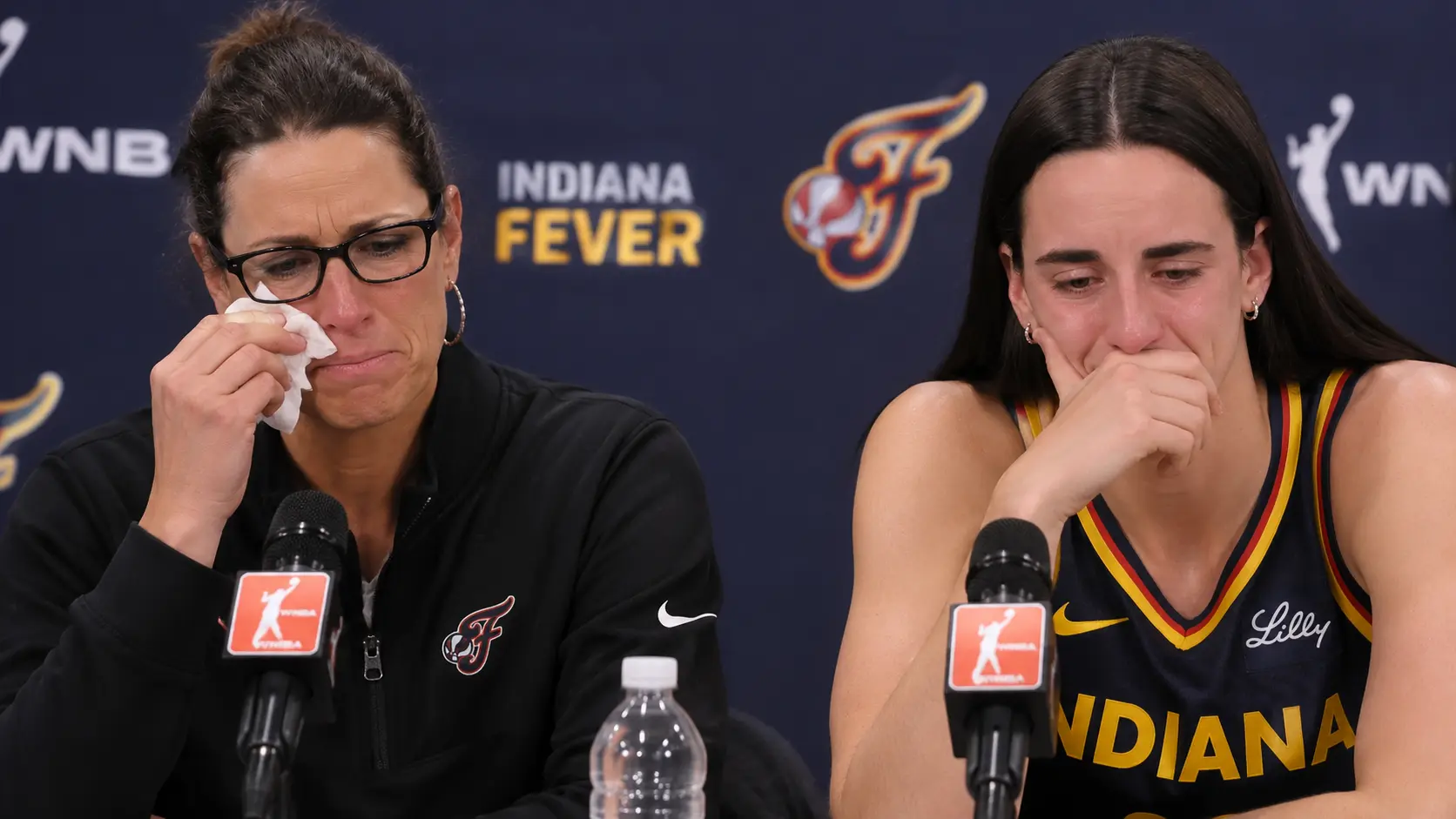
CAITLIN CLARK AND STEPHANIE WHITE: THE EMOTIONAL PRESS CONFERENCE THAT RAISES BIG QUESTIONS ABOUT THE INDIANA FEVER STAR’S HEALTH AND FUTURE
Fictional sports-news feature | Approximately 2,000 words | The press conference, dialogue, and medical developments below are imagined, not verified events.
Fever HC Stephanie White reveals surprising demand Caitlin Clark made from her
sportskeeda.com
INDIANAPOLIS — Few athletes in modern women's basketball have captured the public imagination quite like Caitlin Clark. From her record-breaking college career to her emergence as one of the most recognizable faces in the WNBA, Clark has become a symbol of determination, ambition, and the extraordinary growth of women's sports. But in this fictional scenario, the atmosphere surrounding the Indiana Fever takes an unexpectedly emotional turn when head coach Stephanie White and Clark sit together before reporters to address a deeply personal development.
What begins as an ordinary media appearance quickly becomes something far more emotional. Cameras flash across the room, microphones line the conference table, and journalists wait for answers. Yet the mood is noticeably different from the energetic conversations usually associated with one of basketball's brightest young stars. Clark appears unusually quiet, while White struggles to maintain her composure. Neither woman seems eager to begin speaking, and the silence creates a sense of uncertainty among those gathered.
At the center of this imagined moment is a health-related concern that could potentially affect Clark's immediate basketball schedule. Although the fictional announcement includes discussion of a positive medical test, the precise nature of that result is deliberately left unspecified. A positive result can mean many different things depending on the test involved, and it would be irresponsible to suggest a particular illness or diagnosis without credible medical information.
Still, the hypothetical situation raises a compelling question: How would the Indiana Fever, their coaching staff, and the wider basketball community respond if their most recognizable player suddenly faced a significant personal challenge?
AN EMOTIONAL MOMENT BEHIND THE MICROPHONES
In the imagined press conference, Stephanie White sits beside Clark wearing a dark Indiana Fever jacket. Her expression is serious, and she occasionally looks toward the player sitting next to her. Clark, dressed in team apparel, keeps her hands folded on the table as the room grows quiet.
White begins by acknowledging the concern surrounding the team.
"There are moments in basketball when wins and losses become secondary," she says in this fictional account. "Our responsibility is to support the people who make this organization special, and Caitlin is certainly one of those people."
The statement immediately changes the atmosphere. Reporters exchange glances, unsure what to expect next. White pauses, takes a sip of water, and continues.
"Whatever challenges come our way, we face them together. No player should ever feel that she has to handle something difficult alone."
Beside her, Clark lowers her eyes. The usually confident athlete, known for her competitive intensity and fearless shooting, appears overwhelmed by the attention.
For a moment, neither woman speaks.
The fictional scene illustrates how vulnerable even the most celebrated athletes can become when circumstances extend beyond their control. Fans are accustomed to seeing Clark sprint across the court, launch long-range shots, and direct her teammates with remarkable confidence. Seeing her in an emotionally difficult setting would reveal another side of the athlete: someone navigating the same uncertainty and personal pressures that affect people outside professional sports.
WHY CAITLIN CLARK MEANS SO MUCH TO THE INDIANA FEVER
To understand why a development involving Clark could attract such intense attention, it is important to recognize the remarkable influence she has had on women's basketball.
Clark entered the professional game with extraordinary expectations following her historic career at the University of Iowa. Her exceptional shooting range, court vision, and competitive personality made her one of the most closely followed basketball prospects in recent memory.
When the Indiana Fever selected her with the first overall pick in the 2024 WNBA Draft, the moment represented far more than the arrival of another talented rookie. It marked a new chapter for a franchise eager to build a competitive future and for a league experiencing growing national visibility.
Clark brought with her an enormous following, including longtime basketball enthusiasts and people who had rarely watched women's professional basketball before. Her games became major sporting events, and her performances generated conversations across television, social media, and the wider sports industry.
But that attention also created significant expectations.
Every missed shot, difficult game, injury concern, and coaching decision became a subject of public discussion. While Clark's popularity offered tremendous opportunities, it also placed her under an unusually intense spotlight.
In the fictional press conference scenario, those pressures form an important backdrop. A personal health concern would not simply affect one athlete's schedule. It could become a national conversation about the responsibilities of professional teams, the boundaries of public curiosity, and the importance of protecting athletes during vulnerable moments.
STEPHANIE WHITE'S ROLE AS A COACH AND LEADER
Stephanie White understands the demands of professional basketball from several perspectives. Her experience as a player and coach has given her insight into the physical, emotional, and competitive pressures that shape life in the WNBA.
As a coach, White's responsibilities extend beyond designing offensive plays or making substitutions. She must also help create an environment in which athletes feel supported, respected, and prepared to handle difficult circumstances.
In the fictional scenario, her role becomes particularly important.
Rather than focusing exclusively on Clark's possible availability for upcoming games, White emphasizes the need for patience and privacy.
"We understand that people care deeply about Caitlin," she says in the imagined statement. "But caring about someone also means respecting the things they may not be ready to discuss publicly."
Her words reflect a broader principle in professional sports: an athlete's personal well-being should not be treated as less important than competitive performance.
For a team trying to establish consistency and develop a strong identity, losing a key player temporarily could create tactical difficulties. But the emotional consequences of a serious personal challenge can be just as significant.
Coaches often become central figures during those moments. They help maintain communication, support teammates, and ensure that public expectations do not overwhelm the individuals involved.
In this imagined situation, White's leadership would be measured not by the outcome of a single basketball game but by how effectively she helps her team navigate uncertainty.
THE MEANING OF A POSITIVE TEST RESULT
One of the most important distinctions in any health-related report is the difference between a confirmed medical finding and speculation about what that finding means.
A positive test result, by itself, does not necessarily establish the severity of a medical condition, the expected recovery period, or whether an athlete will be able to compete. The meaning depends entirely on the type of test, the circumstances under which it was performed, and the interpretation of qualified medical professionals.
In this fictional account, no specific diagnosis is established.
That distinction matters because public speculation can quickly turn an incomplete piece of information into an alarming narrative. Social media posts may spread faster than official explanations, and dramatic headlines can create unnecessary fear among fans.
Professional sports organizations typically rely on medical personnel to evaluate health concerns and determine appropriate next steps. Those decisions may involve additional testing, monitoring, rest, treatment, or other measures depending on the circumstances.
For athletes, medical privacy remains an important consideration. Public interest does not automatically create an obligation to reveal every detail of a personal medical situation.
Clark, like any professional athlete, would deserve the opportunity to receive reliable information, consult medical professionals, and make decisions without unnecessary pressure from spectators or commentators.
CAITLIN CLARK'S IMAGINED MESSAGE TO HER SUPPORTERS
As the fictional press conference continues, Clark eventually leans toward the microphone.
Her voice is quieter than the energetic tone fans recognize from postgame interviews.
"I know a lot of people have questions," she says in the imagined exchange. "I appreciate everyone who has supported me, but right now I'm trying to focus on taking things one day at a time."
She pauses before continuing.
"Basketball has given me so much. It's something I love, and being able to compete with my teammates means everything to me. But sometimes life reminds you that there are things bigger than the game."
The statement brings an emotional dimension to the hypothetical situation.
Clark has built her reputation around resilience. Throughout her basketball journey, she has faced enormous expectations, intense defensive pressure, and the constant challenge of performing at an elite level.
Yet resilience does not mean ignoring difficult emotions or pretending that uncertainty does not exist.
In the fictional scene, Clark's willingness to acknowledge vulnerability becomes an important reminder that strength can take many forms. Sometimes it appears as a spectacular performance in front of thousands of spectators. At other times, it means asking for support, accepting uncertainty, or recognizing the need to prioritize personal well-being.
HOW THE INDIANA FEVER COULD RESPOND
If a key player were temporarily unavailable because of a health concern, the Indiana Fever would face several practical challenges.
The first would involve adjusting the team's basketball strategy.
Clark's influence extends well beyond scoring. Her passing, ability to create opportunities, and willingness to attempt difficult shots can shape the way opposing defenses approach Indiana.
Without her, the Fever might need to distribute ball-handling responsibilities differently, change their offensive rhythm, and rely more heavily on contributions from other players.
However, tactical adjustments would represent only one part of the situation.
The organization would also need to manage communication carefully. Teammates could experience concern, reporters might request frequent updates, and supporters would naturally want to know when their favorite player might return.
Clear communication would help prevent unnecessary confusion.
At the same time, the team would need to respect medical privacy and avoid making promises about a return date before reliable information became available.
In the imagined scenario, White emphasizes that the organization will not rush decisions simply because of outside expectations.
"We want every player to feel confident that the people around her have her best interests in mind," she says. "That matters more than any individual game."
Such an approach would reflect an important responsibility shared by coaches, executives, and medical professionals throughout competitive sports.
THE PRESSURE OF BEING ONE OF BASKETBALL'S BIGGEST STARS
Clark's popularity has helped introduce women's basketball to audiences around the world. But widespread attention also creates challenges that are not always visible during games.
Professional athletes live under constant scrutiny. Their performances are analyzed, their public appearances are recorded, and their personal decisions can become subjects of widespread debate.
For a player as recognizable as Clark, even an ordinary absence from practice could generate speculation.
That reality becomes especially complicated when discussions involve health.
Supporters may feel a genuine emotional connection to an athlete, but that connection does not entitle them to private medical information. The distinction between caring about someone and demanding answers is essential.
In the fictional press conference, the tension between public curiosity and personal privacy becomes one of the central themes.
Clark's supporters want reassurance. Reporters want accurate information. The team wants to protect its players while maintaining transparency.
Balancing those interests requires patience, empathy, and responsible communication.
THE POWER OF TEAMMATE SUPPORT
Basketball is often celebrated for individual brilliance, but its strongest moments frequently emerge through collective effort.
When one player experiences difficulty, teammates can provide an important sense of stability.
In this hypothetical situation, the Indiana Fever locker room becomes a source of encouragement for Clark. Players continue preparing for competition while offering emotional support away from cameras.
That support might involve simple gestures: checking in privately, spending time together, offering reassurance, or allowing a teammate space when she needs it.
Not every meaningful act of support requires a public statement.
Sometimes the most valuable assistance comes from maintaining normal routines and reminding someone that their identity extends beyond their performance.
For Clark, whose professional life is so closely connected to basketball, that message could be especially meaningful.
A difficult personal period would not erase her accomplishments, diminish her talent, or change the influence she has already had on the sport.
Her teammates would understand that her value to the organization involves much more than points, assists, or victories.
WHY FANS SHOULD AVOID RUSHING TO CONCLUSIONS
The speed of modern social media can make uncertainty particularly difficult to manage.
A short video clip, an emotional photograph, or an incomplete quotation can quickly spread across multiple platforms. Within minutes, speculation may begin to resemble established fact.
Health-related stories are especially vulnerable to this problem because audiences naturally react with concern.
A photograph of an athlete crying does not prove that a medical emergency occurred. An emotional press conference does not establish a diagnosis. And an incomplete statement about a positive test cannot responsibly be interpreted without knowing what was tested and why.
The fictional scene involving Clark and White illustrates the importance of those distinctions.
Responsible reporting should prioritize verified statements, reliable sources, and clear explanations of what remains unknown.
For supporters, patience is often the most constructive response.
Instead of repeating unverified claims, fans can express encouragement while recognizing that athletes are entitled to personal boundaries.
That approach helps create a healthier environment for both players and the communities that support them.
A BIGGER CONVERSATION ABOUT ATHLETE WELL-BEING
Over recent years, professional sports have experienced growing conversations about the relationship between physical health, emotional well-being, and competitive performance.
Athletes are increasingly recognized as individuals whose lives cannot be reduced to statistics and championship ambitions.
The demands of elite competition are enormous. Training schedules, travel, public scrutiny, and the pressure to perform can all create significant challenges.
For younger stars, those pressures may be intensified by rapid fame and constant attention.
Clark's journey offers a useful example of how quickly an athlete's life can change. In a relatively short period, she moved from being a celebrated college basketball player to becoming one of the most discussed figures in professional sports.
With that visibility comes extraordinary opportunity, but also the responsibility of navigating expectations from millions of people.
In the fictional scenario, White's imagined response reinforces the idea that organizations should build cultures where athletes can communicate openly about challenges without fearing that doing so will diminish their standing.
A strong team environment should encourage both competitive excellence and personal well-being.
Those goals are not contradictory. In many circumstances, they support one another.
WHAT WOULD COME NEXT?
In the imagined final moments of the press conference, White and Clark prepare to leave the room.
The atmosphere remains emotional, but the message is no longer centered exclusively on uncertainty.
Instead, the discussion turns toward patience, support, and the importance of making responsible decisions.
Clark offers one final fictional statement.
"I don't know exactly what every day ahead is going to look like," she says. "But I know I'm surrounded by people who care about me, and that means a lot."
White places a reassuring hand on the table beside her.
The two women stand, exchange a brief glance, and walk away from the microphones.
There is no dramatic announcement of a return date, no attempt to predict medical outcomes, and no suggestion that competitive expectations should determine personal health decisions.
For the imagined audience, that uncertainty becomes part of the story's emotional significance.
Basketball fans are accustomed to knowing the score. They can measure success through statistics, standings, and results. Personal challenges rarely offer such immediate answers.
Sometimes the most responsible response is simply to wait.
FINAL THOUGHTS: MORE THAN A BASKETBALL STORY
Caitlin Clark's importance to women's basketball is undeniable. Her talent, competitiveness, and remarkable popularity have helped shape a transformative period for the sport.
Stephanie White, meanwhile, represents the leadership and experience required to guide athletes through the challenges of professional competition.
Together, they provide a compelling foundation for this fictional exploration of an emotional press conference and the difficult questions that can arise when personal well-being intersects with public expectations.
The central lesson is not about a particular medical result or a predicted absence from the court. It is about the responsibilities shared by teams, journalists, and supporters when discussing an athlete's private life.
Fans can admire Clark's achievements without demanding access to every personal detail. They can appreciate White's leadership without interpreting hypothetical statements as actual announcements. And they can recognize that compassion, accuracy, and respect are essential parts of a healthy sporting culture.
For millions of basketball supporters, Clark will always be associated with extraordinary shots, fearless performances, and unforgettable moments on the court.
But the most meaningful message of this imagined story is much simpler.
Behind every celebrated athlete is a person whose health, dignity, and well-being matter far more than the final score.
Editorial clarification: This is a fictionalized feature inspired by the supplied image concept. It does not report an actual November 13, 2026 press conference, a confirmed positive medical test, or verified quotations from Caitlin Clark or Stephanie White.

 An Extraordinary Moment at the Vatican