🚨 30 MINUTES AGO ON A TV SHOW: DETROIT LIONS HEAD COACH DAN CAMPBELL AND JIMMY FALLON SHARE AN EMOTIONAL MOMENT THAT LEAVES THE STUDIO SPEECHLESS — THE POWERFUL MESSAGE BEHIND THE TEARS! ❤️😭🏈
An imagined television interview featuring Dan Campbell and Jimmy Fallon. The emotional exchange and dialogue below are presented as a creative story, not a verified broadcast.
NEW YORK CITY — The bright lights of a late-night television studio, the excitement of a cheering audience, and the unmistakable energy of Jimmy Fallon created what appeared to be another unforgettable evening of entertainment. But when Detroit Lions head coach Dan Campbell entered the studio, the atmosphere was about to take an unexpected emotional turn.
Known throughout the NFL for his passionate speeches, relentless determination, and extraordinary commitment to his players, Campbell has become one of football's most recognizable coaching personalities.
His emotional leadership has helped define the identity of the Detroit Lions, a franchise whose supporters have endured years of disappointment while continuing to believe that better days were possible.
But on this imagined evening, Campbell was not there simply to discuss football strategy, memorable victories, or the pressure of coaching in the National Football League.
Instead, the conversation gradually became something much more personal.
It was about sacrifice, loyalty, family, and the invisible emotional burden carried by people who are expected to remain strong for everyone around them.
As Fallon introduced Campbell, the studio erupted into applause.
The Lions coach walked onto the stage wearing a dark suit and a familiar determined expression. He greeted Fallon with a firm handshake before taking his seat.
The host immediately began joking about Campbell's legendary intensity.
Fallon laughed as he imagined what it would be like to receive one of Campbell's motivational speeches before an ordinary Monday morning.
"Coach, I feel like if you gave me a speech before breakfast, I'd run through a wall just to get to my cereal!"
The audience burst into laughter.
Campbell smiled and shook his head.
For several minutes, the conversation remained lighthearted.
They discussed the demanding world of professional football, the passion of Detroit supporters, and the unique personality that has made Campbell such a compelling figure.
But then Fallon asked a question that changed the entire mood.
"Dan, everybody sees how much you care about your players. But who takes care of you when things get difficult?"
Campbell stopped smiling.
He leaned back slightly and looked toward the studio floor.
For a moment, he seemed uncertain how to answer.
The audience became quiet.
Then Campbell took a slow breath.
"That's a good question," he said. "Because when you're the guy everybody looks to for answers, sometimes you forget that you're allowed to have tough days too."
Fallon nodded.
The response opened a conversation that went far beyond football.
Campbell reflected on the responsibility of leading a professional team, explaining that coaching involves much more than designing plays or making decisions on game day.
A head coach must understand the personalities, motivations, and emotional challenges of dozens of players.
He must work with assistant coaches, communicate with management, and maintain the confidence of an entire organization.
Every victory brings celebration.
Every defeat brings criticism.
And every decision can affect the lives and careers of people who have dedicated years to the sport.
For Campbell, the emotional weight of that responsibility was impossible to separate from his passion for the game.
"People think coaching is all about winning," he said. "But these are human beings you're working with. They've got families. They've got dreams. They've got things happening in their lives that fans never see."
The audience listened closely.
Campbell continued by explaining that professional athletes are often judged only by their performances.
A missed tackle, an interception, or a dropped pass can become the subject of intense criticism.
But behind every mistake is a person who may already be carrying enormous pressure.
That understanding, he suggested, is essential to building trust within a team.
"You can't just care about somebody when they're making plays for you," Campbell said. "You've got to care about them when things aren't going right."
Fallon leaned forward.
"That sounds like something bigger than football."
Campbell nodded.
"It is."
The exchange brought a different kind of energy into the studio.
For years, Detroit Lions supporters have admired Campbell's willingness to show emotion publicly.
His introductory press conference in 2021 became famous for its passionate language and determination to build a resilient team.
His leadership style has consistently emphasized toughness, accountability, and the importance of responding to adversity.
But toughness, Campbell suggested in the imagined interview, should never be confused with emotional isolation.
There are moments when even the strongest leaders need encouragement.
There are days when confidence becomes difficult to maintain.
And there are situations when the pressure of responsibility can feel overwhelming.
Fallon then asked Campbell about the people who had supported him throughout his coaching journey.
The question brought the conversation toward family.
Campbell spoke warmly about his wife, Holly Campbell, and the importance of having someone who understands the sacrifices associated with professional football.
The NFL demands extraordinary amounts of time.
Coaches spend long hours preparing game plans, studying opponents, evaluating players, and making decisions that may determine the outcome of a season.
Travel, training camps, and constant competition can make ordinary family routines difficult to maintain.
For those closest to a coach, supporting that career often involves sacrifices of their own.
In the imagined conversation, Campbell paused as he reflected on those responsibilities.
"Everybody sees the coach standing on the sideline," he said. "They don't always see the people who helped him get there."
His voice softened.
He explained that success is rarely an individual achievement.
Behind every person celebrated publicly are others who offered support during moments of uncertainty.
Some provided encouragement.
Others offered honest advice.
And some simply remained present when life became difficult.
Campbell described that kind of loyalty as something that cannot be measured by trophies or professional accomplishments.
Fallon appeared visibly moved.
"That's beautiful, Coach."
Campbell smiled faintly.
But the most emotional moment was still ahead.
Fallon reached toward a small stack of cards resting on his desk.
He explained that the show's production team had prepared a special collection of messages celebrating the meaning of perseverance.
Campbell looked surprised.
"Uh-oh," he joked. "What are you guys doing to me?"
The audience laughed.
Fallon began reading.
The first message described a Detroit family that had supported the Lions across multiple generations.
A grandfather had passed his love of the team to his children, who had eventually shared that same passion with their own families.
For them, football was never simply a game.
It was a tradition connecting generations.
The second message came from a young athlete who had struggled with confidence after an injury.
He explained that hearing Campbell speak about resilience had encouraged him to continue working toward recovery.
The third message described a supporter who had experienced a difficult personal period and found comfort in the sense of community surrounding the Lions.
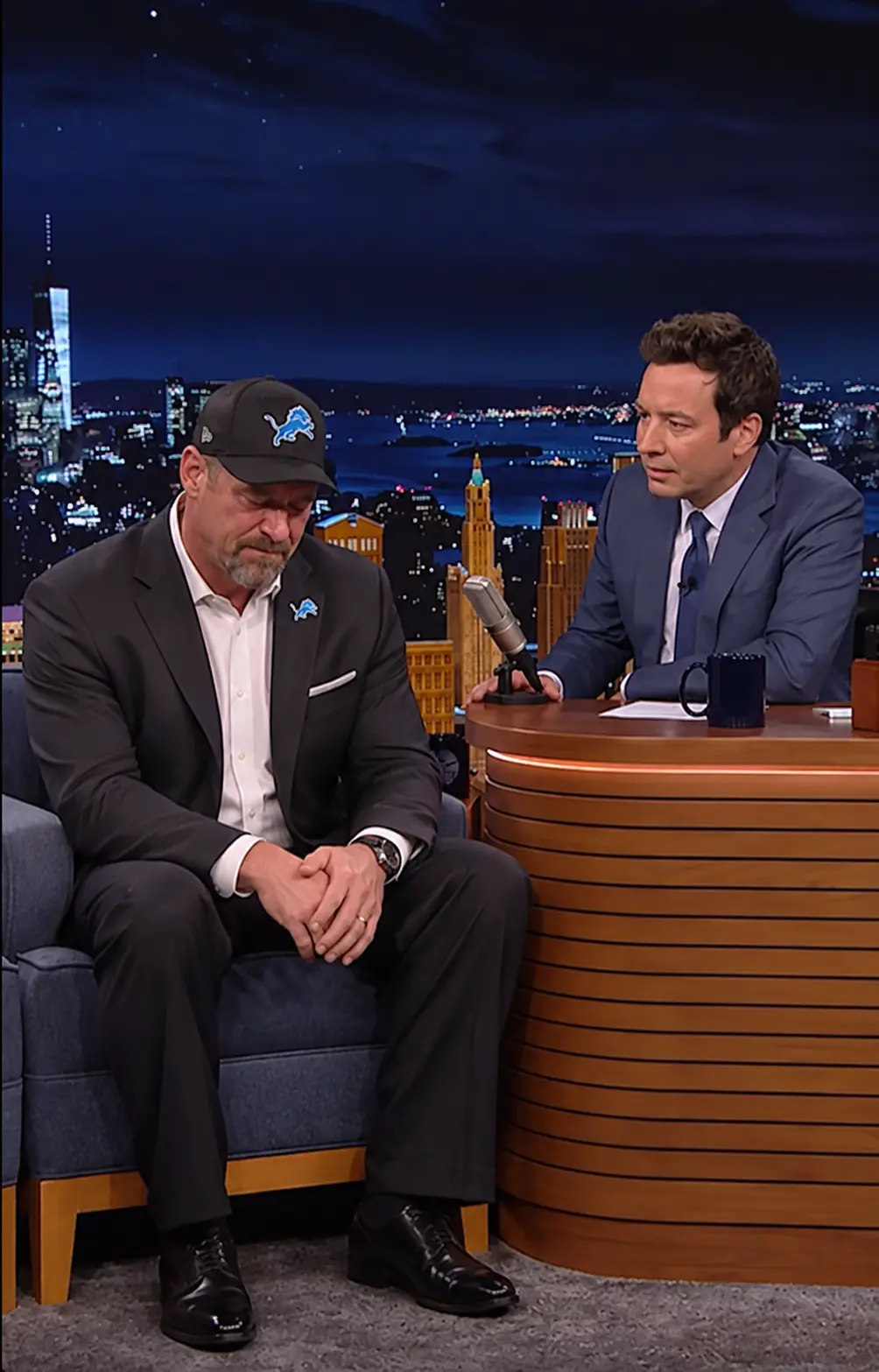
As Fallon continued reading, Campbell became increasingly quiet.
His hands rested together.
His eyes lowered.
And his expression shifted from surprise to deep reflection.
For a coach accustomed to delivering motivational messages, hearing how those words might affect people outside the locker room was an unexpectedly powerful experience.
Fallon stopped reading.
He looked directly at Campbell.
"Dan, I think sometimes you forget how many people are listening when you tell your team not to give up."
Campbell nodded slowly.
For several seconds, he did not speak.
Then he looked toward the audience.
"That's what makes this game special," he said. "You think you're just trying to help your guys get better. But sometimes you find out that what you're doing means something to people you've never even met."
The studio erupted into applause.
Campbell lowered his head briefly.
His eyes appeared moist.
Fallon waited quietly, allowing the moment to unfold without interruption.
The emotional intensity came not from a shocking scandal or unexpected confrontation but from a simple realization.
The influence of a leader can extend far beyond the people standing directly in front of them.
A coach may believe he is speaking only to his players.
Yet the message can reach a parent, a student, a struggling athlete, or someone trying to overcome a difficult chapter in life.
Campbell then reflected on the meaning of resilience.
He explained that the word is often misunderstood.
People associate resilience with refusing to feel pain.
But genuine resilience, he suggested, involves acknowledging difficulty while continuing to move forward.
"Being tough doesn't mean nothing hurts," he said. "It means you keep showing up even when things are hard."
Fallon nodded.
The statement seemed to capture the spirit of Campbell's leadership.
Detroit's football history has included long periods of frustration.
Supporters have experienced difficult seasons, disappointing losses, and moments when optimism seemed difficult to justify.
Yet the fan base has remained deeply passionate.
Campbell's arrival brought a leadership philosophy centered on determination and rebuilding confidence.
His public identity became closely associated with the idea that setbacks do not have to define the future.
During the imagined interview, he emphasized that this philosophy also applies outside professional sports.
A person who loses a job may need courage to begin again.
A student who fails an examination may need encouragement to keep learning.
A family facing hardship may need the reassurance that difficult circumstances do not eliminate the possibility of better days.
Football, he suggested, can provide a powerful metaphor for those experiences.
But the lesson is not that everyone will always win.
It is that people can continue finding purpose even when the outcome is uncertain.
As the conversation approached its conclusion, Fallon asked Campbell one final question.
"What would you tell somebody watching tonight who's going through the hardest moment of their life?"
Campbell took a deep breath.
He looked directly toward the camera.
For a moment, the studio was completely silent.
Then he answered.
"Don't think you've got to carry everything by yourself. Find your people. Let them help you. And when you've got enough strength, turn around and help somebody else."
The audience began applauding.
Campbell continued.
"That's how you build something that lasts. Not just a football team. A family. A community. Anything that matters."
Fallon appeared deeply moved.
He stood from behind his desk and approached Campbell.
The coach rose from his chair.
The two men embraced warmly as the audience offered a standing ovation.
For several seconds, neither spoke.
It was a moment centered on gratitude rather than competition.
Campbell had arrived as an NFL head coach known for his emotional speeches and intense sideline presence.
But the imagined conversation revealed a more personal message about leadership.
Strength does not require pretending that everything is easy.
Success does not eliminate the need for support.
And the people who inspire others may sometimes need encouragement themselves.
When Fallon and Campbell returned to their seats, the host offered a gentle joke.
"Coach, I was planning to ask you about football, and now you've got the whole studio ready to call their families."
Campbell laughed.
"That's not a bad thing."
The audience responded with another round of applause.
The conversation had traveled from football strategy to the deeper meaning of loyalty, sacrifice, and community.
And for the fictional audience watching at home, the message was simple.
The most meaningful victories are not always recorded on a scoreboard.
Sometimes they happen when someone chooses to keep going after disappointment.
Sometimes they happen when a family supports one another through uncertainty.
And sometimes they happen when a leader reminds others that asking for help is not a sign of weakness.
Dan Campbell's reputation has been built around determination, accountability, and emotional investment in his players.
Those qualities have helped make him a recognizable figure in professional football.
But the imagined television moment with Jimmy Fallon highlighted a different aspect of leadership.
The ability to care.
The willingness to listen.
And the understanding that people matter beyond their achievements.
As the studio lights dimmed and the conversation came to an end, Campbell offered one final thought.
"At the end of the day, nobody gets through life alone. The people standing beside you are what make the journey worth it."
The audience applauded once more.
And the message lingered long after the imagined broadcast ended.
Because sometimes the strongest leader in the room is not the person who never sheds a tear — but the person who cares enough to remind everyone else that they are never fighting alone. ❤️😭🏈
#DanCampbell #JimmyFallon #DetroitLions #OnePride #NFL #FootballFamily #EmotionalMoment #Leadership #NeverGiveUp