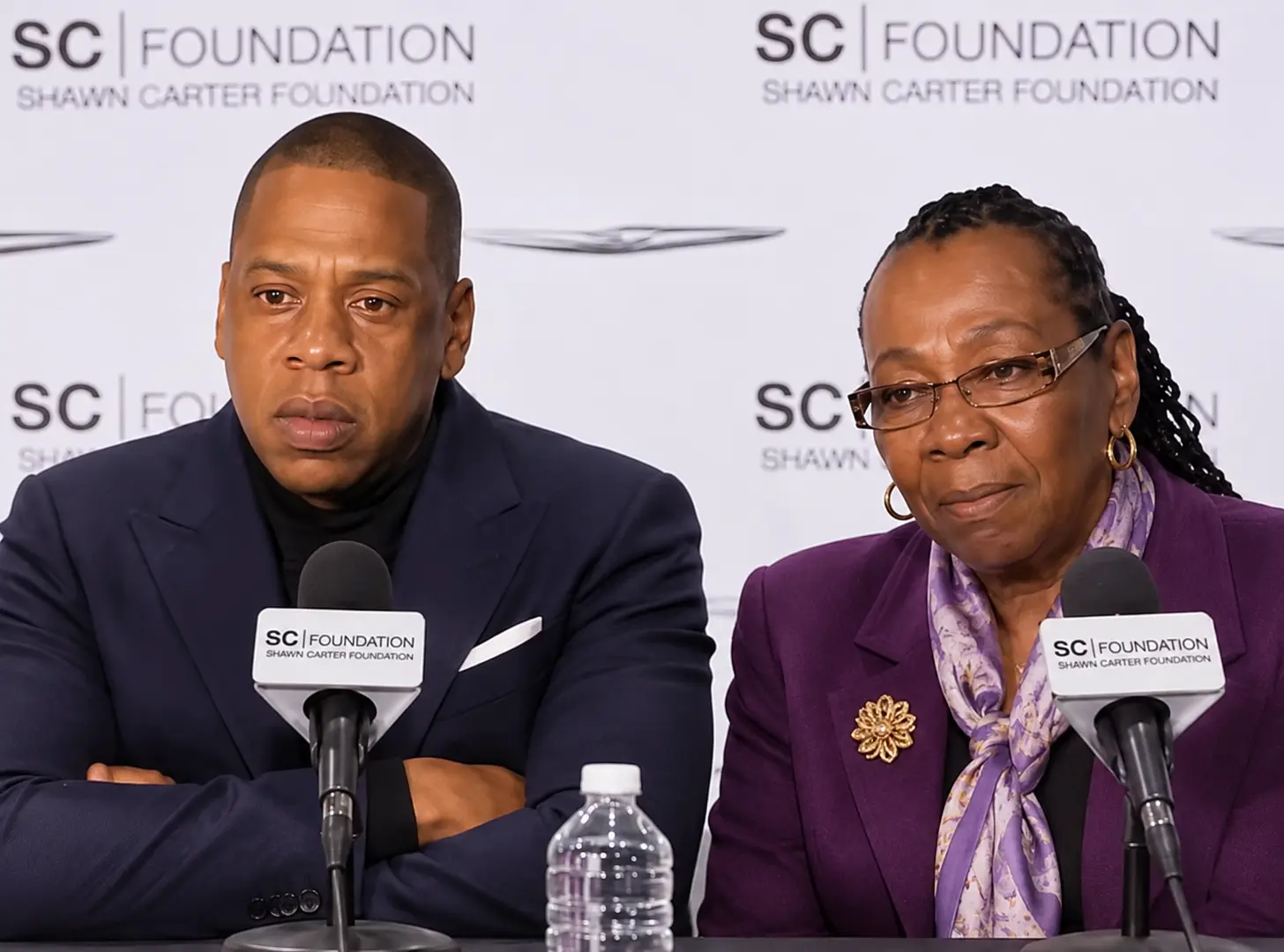
🚨💔 “I CAN'T STAY SILENT ANYMORE…” — JAY-Z AND HIS MOTHER GLORIA CARTER AT THE CENTER OF AN EMOTIONAL FAMILY REVELATION THAT COULD CHANGE EVERYTHING! 😱❤️🎤
NEW YORK CITY — A legendary music mogul. A mother whose strength helped shape one of hip-hop's greatest success stories. And an emotional conversation that raises a powerful question: What happens when a man who has spent decades building an empire finally confronts the personal sacrifices that made his success possible?
For more than three decades, JAY-Z has stood among the most influential figures in American music.
His journey from Brooklyn's Marcy Houses to international recognition represents one of hip-hop's most remarkable stories of ambition, determination, and transformation.
But behind the awards, business achievements, and cultural influence stands another extraordinary figure: his mother, Gloria Carter.
Her presence in his life has long represented resilience, family loyalty, and the importance of remembering where one comes from.
Now, in a dramatic imagined family storyline, an emotional conversation between JAY-Z and Gloria brings years of unspoken gratitude, difficult memories, and deeply personal reflections into the spotlight.
And at the center of everything is one sentence:
"I can't stay silent about this anymore."
Editor's note: This is a fictional entertainment feature inspired by publicly known aspects of JAY-Z and Gloria Carter's relationship. No announcement or family crisis occurring 15 minutes ago has been verified. All private conversations, emotional scenes, and quotations below are imagined.
THE UNEXPECTED MOMENT THAT CHANGES EVERYTHING
The fictional story begins on a quiet evening in New York City.
Inside an elegant private gathering space overlooking Manhattan, a small group of family members, longtime friends, and community supporters has assembled.
There are no elaborate stage decorations.
No flashing paparazzi cameras.
And no massive crowd waiting for a performance.
Instead, the evening has been organized as an intimate celebration of family, perseverance, and the importance of supporting future generations.
JAY-Z arrives wearing a tailored black suit.
His expression is calm but thoughtful.
Gloria Carter sits near the front of the room, greeting guests with a warm smile.
For most of the evening, the atmosphere remains relaxed.
People share memories.
Old photographs are displayed.
And stories about Brooklyn, family life, and personal growth fill the room.
Then JAY-Z approaches a microphone.
He looks toward his mother.
Pauses.
And delivers the unexpected words that change the atmosphere.
"I can't stay silent about this anymore."
The room becomes quiet.
Gloria looks up.
And everyone waits to hear what he will say next.
THE WOMAN BEHIND THE LEGEND
Long before JAY-Z became a globally recognized artist, he was Shawn Carter, a young boy growing up in Brooklyn.
His mother, Gloria Carter, played a central role in his upbringing.
Raising children while navigating financial and social challenges required determination, patience, and sacrifice.
Those early experiences would later influence JAY-Z's understanding of ambition, opportunity, and responsibility.
His music frequently reflects on his childhood, neighborhood, family relationships, and the complicated journey from hardship to success.
But the story of his mother is about more than the struggles of raising a future superstar.
Gloria has developed her own public identity through philanthropy and advocacy.
She has been associated with the Shawn Carter Foundation, which supports educational opportunities for individuals facing socioeconomic barriers.
Her work reflects a belief that access to education can change the direction of a person's life.
In the imagined gathering, JAY-Z reflects on how much of his success began with lessons learned at home.
And for the first time that evening, his voice becomes noticeably emotional.
THE WORDS THAT LEAVE THE ROOM SILENT
In the fictional scene, JAY-Z looks toward Gloria.
"People have spent years talking about what I've accomplished," he begins.
He pauses.
"They talk about the records, the businesses, and everything that came afterward."
Several guests nod.
"But sometimes I wonder whether I've said enough about the people who helped me get here."
Gloria lowers her eyes.
JAY-Z continues.
"When you're young, you don't always understand what sacrifice looks like."
His voice becomes quieter.
"You see your mother working. You see her making decisions. You see her finding a way to keep everything together."
He pauses again.
"But you don't always understand what she had to give up."
The room becomes completely silent.
Then he delivers the emotional centerpiece of the imagined speech.
"The world knows my name because somebody believed in me before the world even knew I existed."
Gloria places a hand against her chest.
And for several seconds, neither speaks.
A CHILDHOOD THAT SHAPED HIS FUTURE
JAY-Z's real-life journey has been closely connected to Brooklyn.
His upbringing in the Marcy Houses public housing development became a defining element of his artistic identity.
Throughout his career, he has explored themes of poverty, ambition, social inequality, personal responsibility, and the complicated choices people face while trying to improve their circumstances.
Those experiences helped shape his storytelling.
But success did not erase the memories of his early life.
Instead, many of those experiences became central to his music.
Albums such as Reasonable Doubt, The Blueprint, and 4:44 demonstrate different stages of his artistic development.
His lyrics have addressed ambition and wealth, but also family, regret, relationships, and personal growth.
The fictional gathering imagines him reflecting on the difference between understanding childhood experiences as a young person and revisiting them decades later.
With age, he recognizes details that once seemed ordinary.
A mother staying awake late.
A difficult financial decision.
A quiet expression of worry.
Or a moment when encouragement mattered more than material possessions.
GLORIA CARTER'S EMOTIONAL RESPONSE
In the imagined scene, Gloria slowly stands.
JAY-Z steps away from the microphone and walks toward her.
He offers his hand.
She takes it.
For a moment, they simply look at each other.
Then Gloria speaks.
"You don't have to thank me for being your mother."
Her voice is gentle but firm.
Several guests smile.
JAY-Z lowers his head.
Gloria continues.
"Parents don't always know whether they're doing everything right."
She pauses.
"We make decisions with what we have, and we hope our children find their way."
Her eyes begin filling with tears.
"But watching you become the person you are today has meant more than you could ever imagine."
JAY-Z embraces her.
The room remains silent.
And in this fictional moment, the international music icon is no longer standing before an audience as a businessman or performer.
He is simply a son holding his mother.
THE PERSONAL REVELATION NOBODY EXPECTED
After the embrace, JAY-Z returns to the microphone.
He explains that the evening has inspired him to reconsider how he measures success.
For decades, his professional achievements have been evaluated through record sales, business ventures, influence, and financial milestones.
But the imagined conversation leads him toward a different conclusion.
"Success changes meaning as you get older," he says.
"When you're young, you want to prove that you can build something."
He pauses.
"Then you start asking what that something is actually for."
He looks toward Gloria.
"Who does it help? Who does it protect? What does it leave behind?"
The questions create a different atmosphere.
The gathering is no longer simply a celebration of past achievements.
It becomes a conversation about responsibility.
JAY-Z then reveals the fictional purpose of the evening.
He wants to begin a new family-centered initiative honoring the people whose sacrifices helped shape future generations.
THE ANNOUNCEMENT THAT BRINGS EVERYONE TO TEARS
In this imagined storyline, JAY-Z introduces a proposed charitable program called The Gloria Carter Legacy Initiative.
The initiative is fictional and should not be confused with any existing organization.
Its imagined mission would focus on supporting parents, caregivers, and young people in underserved communities.
Educational scholarships would form one part of the program.
Another would involve mentoring opportunities for young people interested in music, entrepreneurship, and community leadership.
A third component would recognize parents and caregivers whose contributions often go unnoticed.
JAY-Z explains that the idea was inspired by a simple realization.
"Every successful person has a story," he says.
"But behind many of those stories is somebody who worked quietly and never asked for recognition."
He looks toward his mother.
"And sometimes the most important thing we can do is make sure those people aren't forgotten."
Gloria wipes a tear from her cheek.
Then smiles.
THE POWER OF A MOTHER'S SACRIFICE
The emotional strength of the fictional story comes from a familiar experience.
Many parents spend years making sacrifices their children do not fully understand.
They may postpone personal ambitions.
Work additional hours.
Manage financial uncertainty.
Or place their children's needs before their own.
Those decisions are not always visible.
And they rarely receive public recognition.
Yet their effects can shape entire families.
In the imagined gathering, Gloria reflects on the ordinary nature of those sacrifices.
"You don't wake up thinking you're making history," she says.
"You wake up thinking about what your children need."
She pauses.
"You try to give them a chance."
The statement resonates with the audience because it describes something far beyond celebrity culture.
Not every child becomes a world-famous artist.
But every family contains stories of effort, hope, and responsibility.
And those stories deserve recognition.
A RELATIONSHIP THAT HAS INSPIRED MUSIC
JAY-Z and Gloria Carter's real relationship has appeared in his music.
One particularly significant example is the song Smile, released on his 2017 album 4:44.
The track features Gloria Carter and addresses her personal journey, including her experience of coming out as a lesbian.
The song became an important moment in JAY-Z's artistic exploration of family, acceptance, and emotional honesty.
It also demonstrated how music can provide a space for deeply personal conversations.
Rather than focusing exclusively on wealth or status, 4:44 explored vulnerability, accountability, and relationships.
Those themes help explain why an imagined story about JAY-Z and his mother can carry emotional weight.
His public artistic journey already includes reflections on the importance of family.
The fictional gathering builds on those broader themes without claiming that any new private revelation has occurred.
THE QUESTION ABOUT FAMILY SECRETS
As the imagined evening continues, a guest asks whether JAY-Z's emotional remarks mean that something troubling has happened within the family.
The question creates a brief moment of tension.
JAY-Z looks toward Gloria.
Then shakes his head.
"No," he replies.
"This isn't about revealing some hidden tragedy."
He pauses.
"It's about recognizing things we should have appreciated more openly."
His answer redirects the conversation.
There is no fictional illness announcement.
No sudden family emergency.
And no accusation involving Gloria Carter.
Instead, the emotional revelation concerns gratitude.
The realization that success can sometimes distract people from acknowledging the individuals who helped make it possible.
JAY-Z continues.
"Sometimes we wait until something goes wrong before we say what somebody means to us."
He looks toward the audience.
"Why wait?"
THE MOMENT GLORIA TAKES THE MICROPHONE
In the fictional story, Gloria asks to speak once more.
She approaches the microphone while JAY-Z stands beside her.
Her expression is emotional but composed.
"I appreciate what my son has said tonight," she begins.
"But I want everyone to remember something."
She looks across the room.
"Love isn't measured by how much money you can give somebody."
The audience listens.
"It isn't measured by how famous your family becomes."
She pauses.
"It's measured by whether you show up when somebody needs you."
JAY-Z lowers his head.
Gloria continues.
"Sometimes showing up means helping with a problem."
"Sometimes it means listening."
"And sometimes it simply means reminding somebody that they matter."
The imagined statement receives warm applause.
But Gloria is not finished.
"The greatest thing we can leave our children isn't a fortune. It's the knowledge that they were loved."
THE LEGACY BEYOND MUSIC AND BUSINESS
JAY-Z's real achievements extend across music and entrepreneurship.
His influence on hip-hop has been substantial.
His work helped shape conversations about artistic ownership, business development, and the possibilities available to musicians.
He has also been involved in philanthropic efforts, including educational initiatives through the Shawn Carter Foundation.
But the fictional story asks a broader question about legacy.
What remains meaningful when professional achievements are no longer the center of attention?
For some people, the answer involves family.
For others, it involves community service, mentorship, or creating opportunities for younger generations.
A legacy can include financial resources.
But it can also consist of knowledge, encouragement, and values.
The imagined initiative honoring Gloria Carter represents that broader understanding.
It suggests that achievement becomes especially meaningful when it helps other people pursue their own futures.
THE PRIVATE CONVERSATION AFTER THE EVENT
As the fictional gathering concludes, guests begin leaving.
The room gradually becomes quiet.
JAY-Z and Gloria remain near a large window overlooking the city.
The lights of Manhattan shine in the distance.
For several moments, neither speaks.
Then Gloria turns toward her son.
"You know you didn't have to do all this."
JAY-Z smiles.
"I know."
She looks at him.
"Then why?"
He pauses.
"Because I wanted you to hear it."
Gloria takes his hand.
"I've always known you loved me."
JAY-Z looks down.
"Maybe."
Then he adds:
"But I wanted to make sure you knew how much of my life exists because of yours."
Gloria embraces him.
And the imagined evening ends with a moment far removed from the noise of celebrity culture.
WHY THIS STORY RESONATES BEYOND HIP-HOP
The emotional themes explored in this fictional narrative are universal.
Many adults eventually recognize sacrifices they overlooked during childhood.
Some wish they had asked more questions.
Others regret not expressing appreciation sooner.
And many discover that the people who influenced them most were not necessarily the most publicly celebrated.
They were parents.
Grandparents.
Teachers.
Mentors.
And friends who offered encouragement when success still seemed impossible.
The story also explores the complicated relationship between achievement and emotional fulfillment.
Professional recognition can be rewarding.
Financial stability can provide security.
But neither automatically replaces meaningful human connection.
Sometimes the most powerful expression of gratitude is simply telling someone that their efforts mattered.
THE FINAL MESSAGE THAT LEAVES EVERYONE SPEECHLESS
In the final imagined scene, JAY-Z prepares to leave the building.
A longtime friend approaches him.
"That was a powerful night," the friend says.
JAY-Z nods.
Then looks back toward the room where Gloria is speaking with several guests.
"I've spent years telling stories about where I came from," he replies.
He pauses.
"Tonight, I wanted to honor the person who helped me get there."
The friend smiles.
JAY-Z continues toward the exit.
Outside, New York City remains as busy as ever.
Cars move through the streets.
People hurry along the sidewalks.
And the city's familiar lights illuminate the night.
But the imagined story ends with a message that reaches far beyond the music industry.
The greatest achievements in life are rarely accomplished entirely alone.
Behind many success stories are people whose contributions are never fully recognized.
People who believed before there was evidence.
Who encouraged before there was applause.
And who remained present when the future was uncertain.
For JAY-Z and Gloria Carter, this fictional emotional gathering becomes a celebration of that kind of love.
Not a scandal.
Not a family tragedy.
And not an unverified breaking-news announcement.
But a reminder that gratitude should not have to wait for a crisis.
Because sometimes the most powerful words a son can say to his mother aren't about fame, money, or success.
They're simply: "Everything I became began with the love you gave me." ❤️😭🎤
Editorial disclosure: This is a fictional entertainment narrative. The recent gathering, emotional speech, private conversations, proposed Gloria Carter Legacy Initiative, and all dialogue are invented. No such announcement involving JAY-Z and Gloria Carter has been independently verified.
#JAYZ #GloriaCarter #HipHopLegend #JAYZNews #FamilyLove #MotherAndSon #HipHopCulture #EntertainmentStories #EmotionalStory #FictionalStory #TrendingNow